
Many companies entering the Canadian market assume that every chemical-containing product requires a Safety Data Sheet (SDS), or that an SDS prepared for the United States can be translated into French and used in Canada.
Neither assumption is necessarily correct. In Canada, an SDS is generally required when a product:
- Is intended for use, handling, or storage in a Canadian workplace
- Does not qualify for an applicable exclusion from the Hazardous Products Act (HPA)
- Meets the definition of a hazardous product under the Hazardous Products Regulations (HPR)
The determination must be based on the finished product, its intended Canadian use, its regulatory category, and its hazard classification. The presence of one or more hazardous ingredients does not, by itself, establish that an SDS is required.
- What Is a Safety Data Sheet (SDS)?
- When Is an SDS Required in Canada?
- Does Every Product Containing Chemicals Require an SDS?
- How WHMIS, the HPA, and the HPR Work Together
- Which Products May Be Excluded from WHMIS?
- Who Is Responsible for Determining Whether an SDS Is Required?
- Can a U.S. SDS Be Used in Canada?
- Common Errors When Assessing SDS Requirements for the Canadian Market Entry
- Assuming every chemical product requires an SDS
- Assuming consumer distribution creates an automatic exemption
- Relying only on ingredient Safety Data Sheets (SDSs)
- Copying a foreign SDS without Canadian review
- Treating an exclusion as evidence that the product is unregulated
- Preparing the SDS before completing classification
- Why SDS Applicability Should Be Assessed Before Market Entry
- Confirm Whether Your Product Requires an SDS in Canada
- FAQ About SDS Requirements in Canada
What Is a Safety Data Sheet (SDS)?
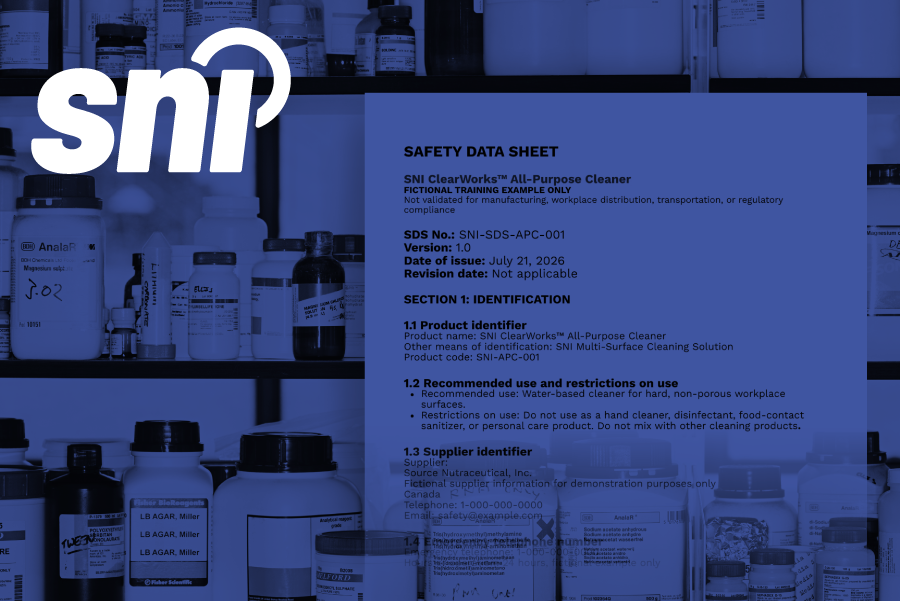
An SDS is a standardized document that communicates information about a hazardous product, including its hazards, composition, safe handling procedures, storage requirements, exposure controls, first-aid measures, and emergency response considerations.
Under the Workplace Hazardous Materials Information System, commonly known as WHMIS, an SDS forms part of a broader hazard communication system that also includes:
- Hazard classification
- Supplier labelling
- Workplace labelling
- Worker education and training
- Safe handling and emergency procedures
An SDS is therefore not a standalone documentation requirement. It is prepared as a result of determining that a product is a hazardous product subject to Canadian WHMIS supplier requirements.

When Is an SDS Required in Canada?
An SDS is generally required when a hazardous product is sold, imported, or supplied for use, handling, or storage in a Canadian workplace.
The assessment involves three primary questions:
- Is the product intended for workplace use in Canada?
- Is the product excluded from some or all WHMIS supplier requirements?
- Does the finished product meet the hazard classification criteria under the HPR?
Only after these questions have been addressed can a manufacturer, importer, distributor, or private-label brand determine whether an SDS is required.

Workplace Use Considerations
The first step is to determine how and where the product will be used in Canada. A workplace may include a manufacturing facility, laboratory, warehouse, construction site, healthcare facility, school, agricultural operation, commercial cleaning environment, or other industrial or institutional setting. When a product is supplied for use in one of these environments, it must be assessed to determine whether it meets the definition of a hazardous product under the HPR.

Personal Use Considerations
Products packaged, labelled, and sold exclusively for personal, family, or household use may instead be regulated under consumer product legislation. These products are generally outside the scope of WHMIS supplier requirements when used as intended by consumers. However, the same formulation may have different regulatory obligations depending on how it is packaged, marketed, distributed, and used.
For example, a household cleaning product sold in a small retail container for domestic use may not require an SDS under WHMIS. The same product supplied in bulk to a commercial cleaning company, healthcare facility, or manufacturing plant may require a Canadian hazard classification, supplier label, and SDS.
The availability of a product through consumer channels does not automatically exempt versions supplied for workplace use.

Does Every Product Containing Chemicals Require an SDS?
No. A product does not require an SDS simply because it contains chemical or potentially hazardous ingredients.
Assess the Finished Product, Not Only Its Ingredients
A product does not require an SDS simply because it contains chemical or potentially hazardous ingredients. The finished product must first be assessed against the physical and health hazard classification criteria established under the HPR.
This assessment may consider the complete composition, ingredient concentrations, physical and chemical properties, product format, potential routes of worker exposure, toxicological information, available finished-product testing, intended conditions of use, foreseeable workplace handling, and applicable concentration limits and mixture classification rules.

How Ingredient Hazards Affect Classification
A hazardous ingredient may contribute to the classification of a finished mixture, but its presence does not automatically mean that the final product receives the same classification.
An ingredient may be hazardous in its concentrated raw-material form but be present below the applicable classification threshold in the finished product. Conversely, several ingredients may collectively contribute to a hazard classification through additive effects or other mixture classification principles.
The SDS requirement is therefore determined by the finished product as supplied in Canada, rather than by reviewing individual ingredient SDSs alone.

How WHMIS, the HPA, and the HPR Work Together
Companies assessing Canadian SDS requirements frequently encounter three related regulatory terms: WHMIS, the HPA, and the HPR. Although these terms are connected, they serve different functions.

Workplace Hazardous Materials Information System (WHMIS)
WHMIS is Canada’s national workplace hazard communication framework. It is designed to ensure that workers receive consistent health and safety information about hazardous products used in Canadian workplaces.
WHMIS includes:
- Product hazard classification
- Supplier labels
- Safety Data Sheets (SDSs)
- Workplace labels
- Worker education
- Product-specific training
WHMIS is aligned with the Globally Harmonized System of Classification and Labelling of Chemicals, but it includes Canadian-specific requirements.

Hazardous Products Act (HPA)
The HPA sets out the core legal obligations and prohibitions for suppliers of hazardous workplace products. It prohibits the sale or import of a hazardous product intended for workplace use unless the required hazard communication obligations have been met, and it gives Health Canada the federal authority to administer and enforce those supplier requirements.

Hazardous Products Regulations (HPR)
The HPR set out the detailed technical requirements that give effect to the HPA, including rules for physical and health hazard classification, classification of substances and mixtures, concentration limits and cut-off values, supplier label content, SDS content, regulatory exceptions, and Canadian supplier requirements.
In practical terms, WHMIS provides the overall hazard communication framework, the HPA makes supplier compliance mandatory, and the HPR specify how a product must be classified, labelled, and documented.

Which Products May Be Excluded from WHMIS?
Before preparing an SDS, a supplier must determine whether the product falls within the scope of the HPA and HPR or qualifies for an applicable exclusion. Certain products may be excluded from some or all WHMIS supplier requirements because they are regulated under another Canadian legislative framework. These may include consumer products, foods, drugs, NHPs, cosmetics, medical devices, pest control products, tobacco and tobacco products, explosives, nuclear substances, and manufactured articles.
An exclusion from WHMIS does not mean that a product is unregulated. It generally means that another regulatory framework applies to the product, or to certain aspects of its hazard or risk communication.
Each exclusion must be assessed against the exact product, its intended use, its packaging, and the regulatory category under which it is supplied.

Consumer Products
Products intended exclusively for personal, family, or household use may fall within the consumer product exclusion when they are regulated under the Canada Consumer Product Safety Act.
Relevant considerations may include:
- Container size
- Product packaging
- Labelling and claims
- Intended users
- Distribution channels
- Foreseeable conditions of use
A product does not qualify for the consumer product exclusion simply because it is sold through a retail channel or is also available to the general public. A commercial or institutional version may still be subject to WHMIS when it is supplied for workplace use and meets the HPR hazard classification criteria.

Cosmetics, Foods, Drugs, and Natural Health Products (NHPs)
Finished products regulated under the Food and Drugs Act may be excluded from certain WHMIS supplier requirements when they meet the applicable regulatory definition and are supplied under that framework. However, the exclusion must be assessed carefully.
For example, a finished cosmetic sold to consumers may not require a WHMIS SDS, while a bulk cosmetic ingredient supplied to a manufacturing facility may require WHMIS assessment.
Similarly, a finished food may be regulated differently from an industrial ingredient used during food manufacturing, and a disinfectant or antimicrobial product may require review under more than one regulatory framework depending on its intended use and classification.
A product name, marketing position, or claim is not sufficient to establish an exclusion. The assessment should consider the product’s composition, intended use, claims, format, packaging, and regulatory classification.

Manufactured Articles
Some products may be excluded from WHMIS supplier requirements if they meet the HPA definition of a manufactured article. A manufactured article generally has a specific shape or design, performs a function that depends on that shape or design, and does not release, or otherwise expose a worker to, a hazardous product under normal conditions of use. However, a finished-looking product does not automatically qualify for exclusion.
Further assessment may be required where normal use, maintenance, repair, processing, or other foreseeable workplace activities could release hazardous dust, fumes, vapours, fibres, or chemicals. The determination should therefore be based on how the product functions and whether workplace exposure may occur, rather than on its appearance alone.

Who Is Responsible for Determining Whether an SDS Is Required?

Supplier Responsibilities Before Market Entry
Responsibility generally rests with the supplier placing the product on the Canadian market. Under the HPA, a supplier includes a person who sells or imports a hazardous product in the course of business. Depending on the supply chain, this may be a Canadian manufacturer, importer, distributor, private-label company, or another organization supplying the product in Canada.
A foreign manufacturer or private-label brand should not assume that an existing international SDS transfers responsibility to another party. The responsible Canadian supplier must ensure that the product has been appropriately assessed, the hazard classification complies with the HPR, a compliant SDS is available when required, the supplier label reflects the same classification, the appropriate supplier information is provided, and the required hazard information is available in English and French.
Employer Responsibilities in the Workplace
Once the hazardous product reaches a workplace, responsibility shifts to the employer for workplace implementation. This includes maintaining access to current SDSs, providing WHMIS education and product-specific training, applying workplace labels where required, and implementing appropriate handling, storage, exposure-control, and emergency procedures.

Can a U.S. SDS Be Used in Canada?

U.S. SDS May Not Meet Canadian Requirements
A U.S. OSHA-compliant SDS should not be used in Canada without first undergoing a Canadian compliance review. Although Canada and the U.S. both apply GHS principles, their regulatory frameworks are not identical.
A U.S. SDS may require revisions to the hazard classification, supplier identification, bilingual content, hazard and precautionary statements, regulatory references, composition disclosure, and alignment with the supplier label.

What a Canadian Compliance Review Should Confirm
Translating a U.S. SDS into French does not, by itself, make the document compliant with Canadian WHMIS requirements. The SDS should first be reviewed to confirm that the product has been appropriately classified under the HPR and that all Canadian supplier, language, content, and labelling requirements have been addressed.

Common Errors When Assessing SDS Requirements for the Canadian Market Entry
Companies entering the Canadian market often encounter compliance issues because the SDS decision is made too late or is treated primarily as a translation exercise.
Common errors include:
Assuming every chemical product requires an SDS
The requirement depends on workplace use, exclusions, and finished-product classification. Chemical content alone is not determinative.
Assuming consumer distribution creates an automatic exemption
A product may be sold to consumers and workplaces through different channels. Each intended use and supply format should be assessed.
Relying only on ingredient Safety Data Sheets (SDSs)
Raw-material SDSs are important technical sources, but they do not establish the classification of the finished mixture.
Copying a foreign SDS without Canadian review
A U.S. or international SDS may not reflect Canadian classification, language, supplier, or regulatory requirements.
Treating an exclusion as evidence that the product is unregulated
A WHMIS exclusion may place the product under another federal regulatory framework. The applicable obligations must still be identified.
Preparing the SDS before completing classification
An SDS should communicate the outcome of the hazard classification process. It should not be used as the starting point for determining the product’s hazards.

Why SDS Applicability Should Be Assessed Before Market Entry

Assess SDS Requirements Before Market Entry
Determining whether an SDS is required should form part of the broader Canadian market-entry assessment. An early review can establish whether WHMIS applies, whether another regulatory framework governs the product, whether the finished product requires hazard classification, and whether additional formulation or technical information is needed. It can also determine whether an existing SDS may be adapted for Canada, whether a new Canadian SDS is required, whether the supplier label must be revised, and which company is responsible for Canadian compliance.

Reduce Compliance and Supply-Chain Risk
Addressing these questions before importation or distribution can reduce the risk of unsupported hazard classifications, incomplete Canadian documentation, border or supply-chain delays, customer requests for revised SDSs, inconsistencies between the supplier label and SDS, product launch delays, and costly post-market corrections. A compliant Canadian SDS begins with an accurate regulatory and scientific assessment, not with the translation of an existing document.
Confirm Whether Your Product Requires an SDS in Canada
Determining whether a product requires an SDS involves more than reviewing its ingredient list or translating an existing U.S. document. Its intended use, regulatory category, finished-product classification, packaging, and Canadian supply chain must all be considered.
How SNI Supports Canadian SDS Compliance
Source Nutraceutical, Inc. (SNI) supports manufacturers, importers, distributors, and private-label brands with SDS applicability assessments, Canadian hazard classification, preparation of new SDSs, adaptation of U.S. and international SDSs for Canadian requirements, bilingual document support, supplier label reviews, and ongoing SDS portfolio management.
Assessing SDS and WHMIS requirements before market entry can reduce regulatory risk, improve supply-chain confidence, and help establish a more efficient path to Canadian compliance.

Book an introductory call using the following form:
FAQ About SDS Requirements in Canada
Do all products sold in Canada require an SDS?
No. An SDS is generally required only when a product meets the definition of a hazardous product under the HPR and is intended for use, handling, or storage in a Canadian workplace.
Do non-hazardous products require an SDS?
Generally, no. A product that does not meet the HPR definition of a hazardous product does not require an SDS under WHMIS. Some companies may voluntarily provide safety information for commercial purposes, but a voluntary SDS should not incorrectly imply that the product is WHMIS-classified.
Do consumer products require an SDS?
Not necessarily. Products packaged, labelled, and sold exclusively for personal, family, or household use may be regulated under the Canada Consumer Product Safety Act rather than WHMIS. Products supplied to commercial, industrial, or institutional workplaces should be assessed separately.
Does an imported product require a Canadian SDS?
An imported product requires a Canadian-compliant SDS when it is a hazardous product supplied for workplace use in Canada. A foreign SDS may require updates to its classification, language, supplier information, regulatory references, and other content.
Does a private-label product need an SDS?
A private-label product may require an SDS when it is a hazardous product supplied for workplace use. The private-label company should establish who is responsible for classification, SDS preparation, supplier identification, labelling, and updates.
Can SNI prepare an SDS for a product sold in Canada?
Yes. Source Nutraceutical, Inc. (SNI) can support the preparation and review of Safety Data Sheets (SDSs) for products supplied to Canadian workplaces. This includes assessing the finished formulation against the applicable hazard classification criteria, developing the required 16-section SDS, and aligning the content with Canadian WHMIS requirements under the Hazardous Products Regulations (HPR).
What information does SNI need to prepare an SDS?
Source Nutraceutical, Inc. (SNI) typically requires the complete product formulation, ingredient concentrations, supplier SDSs, physical and chemical properties, intended use, product format, toxicological information, and any available finished-product testing. The quality and completeness of the source information directly affect the accuracy of the classification and SDS content.
Can SNI review or update an existing SDS?
Yes. Source Nutraceutical, Inc. (SNI) can review an existing SDS for Canadian compliance, identify missing or outdated information, assess whether the hazard classification remains appropriate, and update the document where required. This may be particularly important when a formulation changes, new ingredient data become available, or the SDS no longer reflects current Canadian requirements.
The content on this website, including information presented in this post, is provided for general informational purposes only and does not constitute legal, regulatory, or professional advice. While efforts are made to ensure accuracy, laws and regulations vary by jurisdiction and may change over time. Readers should not rely on this information as a substitute for advice from qualified legal or regulatory professionals. We disclaim any liability for actions taken based on this content, and users are encouraged to seek guidance specific to their circumstances.