
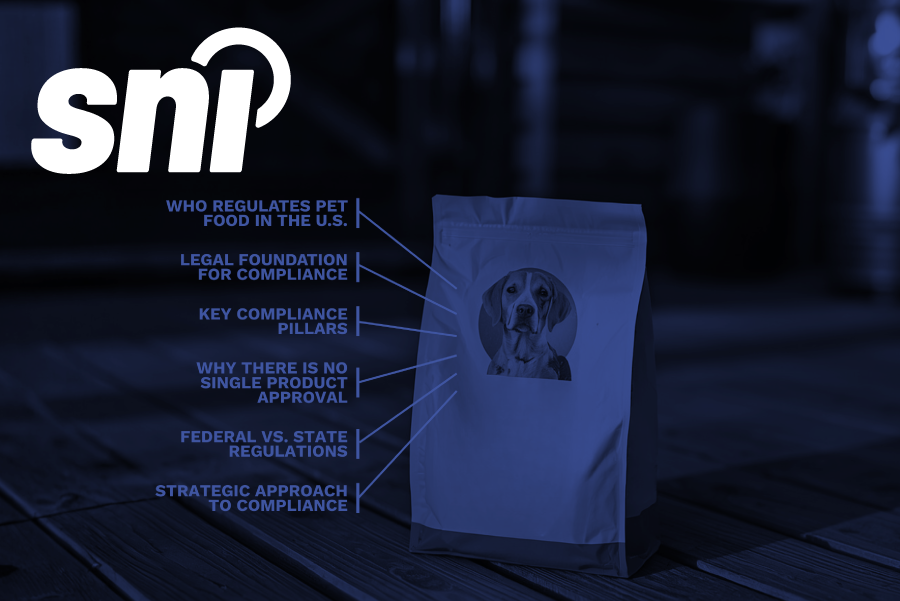
Entering the United States pet food market requires a fundamentally different regulatory mindset than many other jurisdictions. Unlike countries that rely on centralized product licensing or pre-market authorization frameworks, the U.S. operates on a compliance-based system. There is no single approval that permits a pet food product to be sold nationally. Instead, regulatory acceptability is determined by whether the product meets a series of legal, safety, and labelling requirements at both the federal and state levels.

At the federal level, pet food is regulated as “animal food,” meaning it falls within the broader food safety and compliance framework rather than a distinct pet-specific regulatory category. At the same time, individual states impose their own requirements related to product registration, labelling, and distribution. This creates a multi-layered regulatory environment where federal compliance is necessary but not sufficient for full market access.
For international manufacturers and importers, this distinction is particularly important. Products that are compliant in Canada, the European Union, or other jurisdictions often require reformulation, relabelling, or repositioning to meet U.S. standards. As a result, regulatory strategy must be treated as a foundational component of market entry, not a downstream activity.
Who Regulates Pet Food in the U.S.
The primary federal authority overseeing pet food is the U.S. Food and Drug Administration (FDA), specifically through its Center for Veterinary Medicine. FDA is responsible for ensuring that pet food products are safe to consume, produced under sanitary conditions, contain only lawful ingredients, and are truthfully and adequately labelled.

Federal Food, Drug, and Cosmetic Act and Pet Food
FDA’s authority is derived from the Federal Food, Drug, and Cosmetic Act (FD&C), which establishes the legal standards for food safety and labelling. Under this framework, pet food is not regulated as a separate category with its own approval pathway, but rather as part of the broader animal food system.
State Level Regulation of Pet Food
The regulatory oversight of pet food does not end at the federal level. Individual U.S. states play a significant role in governing how pet food products are marketed and sold within their jurisdictions. State authorities are responsible for product registration, label review in certain cases, and enforcement of state-specific requirements. While many states align their frameworks with model guidance developed through organizations such as Association of American Feed Control Officials (AAFCO), there is no single harmonized national system.
Although AAFCO is not a regulatory authority, its Model Bill and ingredient definitions function as the operational standard for most state feed control programs. As a result, state product registration and label acceptance generally track AAFCO definitions, formats, and guidance, making AAFCO central to ingredient acceptance and labeling consistency across jurisdictions.

Implications of Dual Regulatory Structure for Pet Food
The dual structure under which pet food products are regulated in the U.S. introduces a critical operational reality. A product that meets FDA requirements may still be prevented from sale in a given state if it has not met local registration or labelling expectations. As a result, successful commercialization requires coordination across both regulatory layers.

Legal Foundation: Safe, Not Adulterated, Not Misbranded
At its core, U.S. pet food regulation is built on three legal principles. Products must be safe, not adulterated, and not misbranded.
Adulterated Pet Food Products
A product is considered adulterated if it contains harmful substances, is contaminated, or is otherwise unsafe for consumption. This can arise from issues such as microbiological contamination, chemical residues, improper processing conditions, or the inclusion of ingredients that are not legally permitted for use in animal food.
Misbranded Pet Food Products
A product is considered misbranded if its labelling is false, misleading, or incomplete. This includes inaccurate claims, omission of required information, improper ingredient declarations, or presentation that creates a misleading impression of the product’s nature or benefits.
Post-Market Oversight of Pet Food Products
Importantly, the responsibility for ensuring compliance rests with the manufacturer or distributor placing the product on the market. Unlike regulatory systems that rely on pre-market approvals, the U.S. framework places emphasis on industry accountability, supported by post-market oversight, inspections, and enforcement actions.
This means that compliance must be proactively built into the product at every stage, from formulation through to labelling and marketing.

Key Compliance Pillars for Pet Food
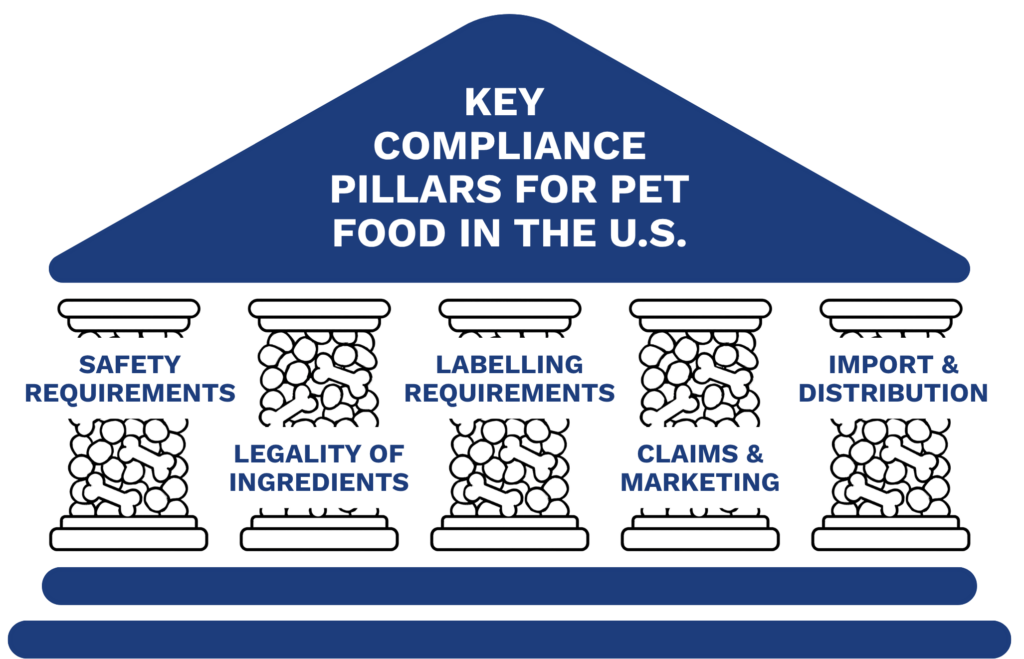
Although the regulatory framework may appear fragmented, it can be effectively understood through five core compliance pillars. Each of these areas plays a distinct role in determining whether a pet food product can be legally marketed in the U.S.
Pet Food Safety Requirements
Food safety is the operational backbone of compliance. Under the Food Safety Modernization Act (FSMA), facilities that manufacture, process, pack, or hold pet food must comply with the Preventive Controls for Animal Food rule (21 CFR Part 507). This includes implementing Hazard Analysis and Risk-Based Preventive Controls (HARPC), meeting current Good Manufacturing Practices (cGMPs) for animal food (Subpart B), and maintaining a documented food safety system to identify and control known or reasonably foreseeable hazards.
For foreign manufacturers, compliance is typically demonstrated through importer oversight and supply-chain controls under FSMA.
Legality of Pet Food Ingredients
Ingredient legality determines whether a formulation can be marketed. Each ingredient must be safe for its intended use and supported by a valid U.S. regulatory pathway, such as food additive approval, determination as Generally Recognized As Safe (GRAS), or inclusion as a defined ingredient in the AAFCO Official Publication (widely adopted by state feed control authorities). In short, ingredients must be permitted under applicable regulations or otherwise supported by accepted regulatory determinations.
Pet Food Labelling Requirements
Labelling requirements govern how the product is presented to the market. Pet food labels must include specific mandatory elements, follow formatting rules, and accurately reflect the product’s composition.
Pet Food Claims and Marketing
Claims and marketing define how the product is positioned. Claims must remain within the scope of food and cannot cross into drug territory. Even subtle wording can significantly alter the regulatory classification of the product.
In practice, the line is drawn by intended use. Structure/function claims (e.g., “supports joint health” or “supports skin and coat health”) are generally permitted for pet food when they are truthful and not misleading. By contrast, claims that imply the diagnosis, treatment, mitigation, or prevention of disease (e.g., “treats arthritis” or “reduces inflammation associated with joint disease”) may cause the product to be regulated as a drug under the Federal FD&C Act.
Pet Food Import and Distribution
Imports and distribution introduce an additional layer of compliance, particularly for foreign manufacturers. Imported products must meet the same standards as domestic products; however, they are subject to additional compliance and enforcement mechanisms at the border and within the supply chain.
Shipments must meet FDA Prior Notice requirements under the Bioterrorism Act and are reviewed by U.S. Customs and Border Protection (CBP) in coordination with FDA. Noncompliant products may be refused entry or placed on FDA Import Alerts, which can result in detention without physical examination (DWPE). Importers also remain responsible for supplier compliance under applicable FSMA frameworks, underscoring that regulatory accountability extends beyond the border.
Each of these pillars operates independently but is also interconnected. Misalignment in any one area can delay or prevent market entry.

Why There Is No Single Product Approval
One of the most common misconceptions among companies entering the U.S. market is the assumption that a central product approval process exists for pet food. In reality, this model applies to regulated categories such as drugs, not to conventional pet food products.
Pet Food Compliance-Based Framework
Pet food is regulated under a compliance-based framework, meaning products may be marketed as long as they meet all applicable legal and regulatory requirements. There is no single, universal pre-market licence or authorization that confirms full regulatory compliance for pet foods. Instead, responsibility rests with the manufacturer and/or the responsible party to ensure compliance with all relevant federal and provincial regulations.

Responsibilities of Pet Food Manufactures and Brands
As pet food products are regulated in a post-market approach, manufacturer and/or the responsible party must independently ensure that the formulation uses lawful ingredients, the manufacturing process meets food safety requirements, the label complies with federal and state rules, and all claims are appropriately substantiated and positioned.
Post-Market Oversight for Pet Foods and Risks
Post-market regulation of pet food products places a greater burden on internal regulatory validation. Non-compliance is typically identified through inspections, audits, or enforcement actions after a product has entered the market, which may result in recalls, warning letters, or distribution restrictions.
As a result, successful market entry depends on front-loaded regulatory due diligence, rather than reactive correction.

Federal vs. State Complexity
While FDA establishes the federal baseline for safety, ingredients, and labelling, state-level requirements ultimately determine how and where a pet food product can be sold.
State Specific Pet Food Registration
Most U.S. states impose jurisdiction-specific pre-market requirements for pet food products prior to sale. These requirements vary by state and may include product registration or listing, mandatory label submission or review, and licensing of manufacturers or distributors, often accompanied by applicable fees and annual renewals.
Given the absence of full regulatory harmonization, the term “registration” is commonly used as a catch-all; however, it does not denote a standardized or uniform process across all state jurisdictions.
In practice, these state-level requirements are often the primary determinant of market access timelines, particularly for companies seeking multi-state distribution. In some states, mandatory label reviews can add additional timelines and require revisions before commercialization.
Implications of State Specific Regulatory Differences
The lack of full harmonization between states creates practical challenges for companies seeking national distribution. Requirements can vary in terms of documentation, review timelines, and enforcement expectations. As a result, companies often adopt a phased approach, prioritizing key states prior to broader expansion.
This layered system has direct operational implications. Delays in state registration can slow product launches, complicate logistics, and increase administrative burden. It also reinforces the importance of designing labels and regulatory strategies that can be applied consistently across multiple jurisdictions.

Strategic Approach to Compliance for Pet Food
Given the complexity of the U.S. regulatory framework, a structured and proactive approach is essential.
Comprehensive Regulatory Assessment of Pet Food Products
Market entry should begin with a comprehensive regulatory assessment that evaluates formulation, ingredient permissibility, claims, and intended market positioning. Conducting this analysis early helps identify potential barriers before significant resources are committed to production or packaging. It also ensures the product meets the regulatory definition of pet food and does not cross into the drug category.
Alignment Across Federal and State Requirements
Alignment across functions is equally critical. Formulation, marketing, and labelling decisions must be developed in parallel to ensure consistency. For example, a claim that is not supported by the ingredient profile can create regulatory risk, even if the label itself is technically compliant.
Considerations for Pet Food Importers
For international companies, additional considerations include import requirements, supplier verification obligations, and coordination with U.S.-based importers or distributors.
Engaging experienced regulatory partners can significantly streamline this process. By integrating regulatory strategy into product development and commercialization planning, companies can reduce delays, avoid costly rework, and position themselves for sustainable market entry.

Final Remarks
U.S. pet food regulation is often perceived as complex, but in practice it follows a clear logic. Compliance is achieved not through a single approval, but through the successful alignment of safety, formulation, labelling, claims, and distribution requirements.
For manufacturers and importers, the key is not simply understanding the rules, but understanding how they interact. When approached strategically, this framework becomes manageable and can support efficient, compliant entry into one of the most significant pet food markets globally.
A Strategic Regulatory Partner for U.S. Pet Food Market Entry
Bringing a pet food product to market in the United States requires coordinated compliance across ingredient permissibility, FSMA requirements, labelling, claims substantiation, and state-level pre-market obligations. Gaps in any of these areas can delay market entry or create enforcement risk post-launch.
At SNI, we support pet food brands through a structured regulatory approach, including ingredient assessments, FSMA alignment, label and claims review, and import readiness.
Our approach integrates regulatory requirements directly into product development and commercialization planning, ensuring that formulation, positioning, and packaging are aligned from the outset. From U.S. market entry strategy through to state-level rollout, SNI provides the technical and operational support needed to move forward with clarity, reduce rework, and maintain compliance as your portfolio expands.
⬇️ Send us a request to learn more about our regulatory solutions
FAQ
There is no single federal “pet food licence” issued by the U.S. FDA. Most conventional pet foods do not require pre-market approval. However, facilities that manufacture, process, pack, or hold animal food are typically required to register with the FDA, and products must comply with all applicable federal requirements. In addition, most states require products to undergo a form of pre-market notification or authorization prior to sale, which often becomes the determining factor for market access.
Not necessarily. Ingredient acceptability is jurisdiction-specific, and regulatory approval in Canada or the European Union does not automatically translate to compliance in the United States. Each ingredient must be lawful for its intended use under U.S. requirements, whether through established use, GRAS status, or an applicable approval pathway. A product that is compliant internationally may still require reformulation for the U.S. market.
“Complete and balanced” is a nutritional adequacy claim indicating that a pet food provides all essential nutrients required for a defined life stage. Substantiation is typically achieved either through formulation in accordance with AAFCO Dog and Cat Food Nutrient Profiles or via AAFCO-recognized feeding trials. This designation is distinct from marketing claims such as “premium” or “natural,” which do not relate to nutritional sufficiency.
The National Research Council (NRC) establishes foundational scientific nutrient recommendations for dogs and cats. While these are not legally binding and are not applied directly as regulatory compliance criteria in the U.S., they underpin the development of AAFCO nutrient profiles, which serve as the regulatory benchmark for nutritional adequacy labelling.
Learn more about AAFCO Pet Food Standards in our prior article: https://sourcenutra.com/2026/01/aafco-pet-food-standards/
There is no fixed timeline, as market entry depends on several regulatory factors. These include ingredient compliance, label development, and state-level product registration. In practice, state registration processes are often the primary driver of timelines, particularly for multi-state distribution. Products that are fully aligned from a regulatory perspective can move more efficiently, while misalignment can result in delays or reformulation.
Non-compliance can trigger a range of enforcement actions from the U.S. FDA and state regulators. These may include product recalls, warning letters, import refusals, or distribution restrictions. Corrective actions typically involve relabelling, reformulation, or removal of non-compliant claims. Beyond regulatory consequences, non-compliance can also result in reputational damage and disruption to commercial operations.
The content on this website, including information presented in this post, is provided for general informational purposes only and does not constitute legal, regulatory, or professional advice. While efforts are made to ensure accuracy, laws and regulations vary by jurisdiction and may change over time. Readers should not rely on this information as a substitute for advice from qualified legal or regulatory professionals. We disclaim any liability for actions taken based on this content, and users are encouraged to seek guidance specific to their circumstances.


