
Health Canada’s Updated NHP Labelling Proposal: What Industry Should Know About Flexibility, Digital Labelling, and the New Transition Timeline
In the recent Natural Health Product Licensing Bulletin No. 10, published on May 11, 2026, Health Canada has confirmed that the current compliance date for the 2022 amendments to the natural health product (NHP) labelling requirements remains June 21, 2028. However, the Department has also indicated that it plans to amend the labelling provisions in the Natural Health Products Regulations to make the requirements more flexible.
Draft regulations are targeted for pre-publication in the Canada Gazette, Part I in spring 2027, and Health Canada has indicated that these amendments will include a proposed transition period beyond June 2028. For NHP licence holders, importers, private label brands, and retailers, this update creates an important planning window. The core objective of clearer and more legible NHP labelling remains in place, but the path toward compliance is expected to become more practical and adaptable.
Health Canada’s recent stakeholder presentation provides additional insight into the policy direction under consideration, including possible changes related to the Product Facts Table (PFT), digital labelling, medicinal ingredient presentation, topical allergen labelling, small package guidance, and transition timing.
- Health Canada NHP Labelling Requirements: Background to the 2022 Amendments
- NHP Labelling Challenges Identified by Stakeholders
- Updated NHP Labelling Proposal: Health Canada’s Policy Direction
- Key Proposed NHP Labelling Changes Industry Should Watch
- NHP Labelling Transition Period and Regulatory Timeline
- Practical NHP Labelling Strategy for Industry
- Final Remarks
- FAQ
Health Canada NHP Labelling Requirements: Background to the 2022 Amendments
The 2022 NHP labelling amendments were introduced to improve how key safety, use, and product information appears on NHP labels. Before assessing the latest update, it is important to understand why the changes were introduced and how the implementation timeline has evolved.
Why Health Canada Updated NHP Labelling Rules
The amendments to the Natural Health Products Regulations were intended to make NHP labels clearer, more consistent, and easier for consumers to read. Health Canada’s objective was to ensure that consumers could more readily identify important information such as medicinal ingredients, recommended use or purpose, directions, warnings, and other conditions of use.
The Original NHP Labelling Transition Timeline
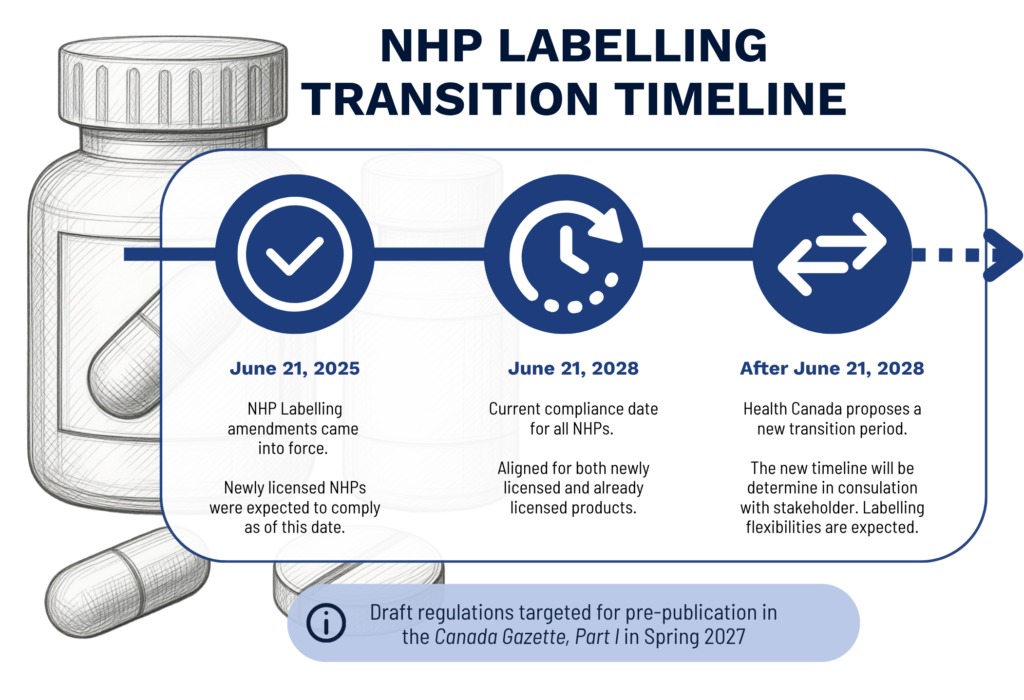
The amended labelling requirements came into force on June 21, 2025. Initially, the newly licensed NHPs were expected to comply with the new requirements as of that date, while products already licensed before June 21, 2025 had until June 21, 2028 to transition.
Why the June 2028 NHP Labelling Date Is Being Revisited
Following stakeholder feedback, Health Canada acknowledged that implementation has been challenging for certain product types and packaging formats. The Department has since aligned the compliance date for newly and previously licensed products to June 21, 2028, and has now signalled that the transition deadline will be extended in the coming updates.

NHP Labelling Challenges Identified by Stakeholders
Health Canada’s stakeholder engagement process has played a central role in the proposed shift in policy direction. While stakeholders generally understood the intent of the 2022 amendments, many noted that certain requirements were difficult to implement in practice.
Label Space and Readability Constraints
Stakeholders reported that the current framework can make it challenging to include all required information on the physical label while still maintaining readability. This concern is especially relevant for products with multiple medicinal and non-medicinal ingredients, several risk statements, bilingual labelling obligations, or limited packaging space.
Product Facts Table (PFT) Implementation Challenges
The PFT was a major focus of stakeholder feedback. Health Canada heard that the rigid format, prescribed content order, and mandatory formatting elements created practical design and layout challenges. Stakeholders also noted that some available flexibilities were costly or difficult to apply, and that the table reduced usable label space.
Need for Clearer Labelling Guidance
Stakeholders also identified the need for clearer, more practical guidance, particularly for small packages and products with complex labelling requirements. Health Canada has indicated that updated guidance will form part of the implementation strategy, including more specific direction for small package scenarios.

Updated NHP Labelling Proposal: Health Canada’s Policy Direction
Health Canada’s updated direction, as discussed during the stakeholder presentation, appears to preserve the consumer protection objectives of the 2022 amendments while reducing unnecessary prescription in how those objectives are met. The proposed approach is not a withdrawal of the labelling reforms, but rather a recalibration of their implementation.
More Flexible NHP Labelling Requirements
Health Canada has identified burden reduction as a key objective, including reducing prescriptive requirements, simplifying regulations, prioritizing key information, and developing clearer guidance. This suggests that the amended framework may give companies more flexibility in how required information is displayed, while still maintaining core legibility and consumer information standards.
Consumer Safety Information Will Remain Central
The updated proposal continues to prioritize consumers’ ability to understand health risks and make informed choices. Health Canada has indicated that certain standardization and legibility requirements would be retained, particularly where they support consumers’ ability to locate, understand, and compare key product information.
Digital Labelling and E-Labels for NHPs
Health Canada is also exploring greater use of digital labelling. The policy direction includes allowing some information to be available digitally, using technologically neutral language, and incorporating modern tools that can adapt over time. This may allow certain detailed information to be provided through mechanisms such as a QR code or URL, while still ensuring that essential information remains accessible.

Key Proposed NHP Labelling Changes Industry Should Watch
Health Canada’s recent stakeholder update suggests that the future NHP labelling framework may become more flexible, while still preserving the core objective of clear, readable, consumer-facing product information. The main areas industry should monitor include the PFT, digital labelling, medicinal ingredient presentation, and continued expectations for ingredient and allergen disclosure.
Product Facts Table (PFT) Flexibility
Health Canada has indicated that the PFT may no longer be required if key information is presented clearly under standardized bold headings and meets minimum standards for type size, font, and contrast. Companies may still choose to use a PFT, so those that have already invested in PFT-style labels may be able to build on that work rather than discard it.
Digital Labelling for NHPs
Digital labelling may play a larger role for detailed or technical information, such as details about medicinal ingredients or certain conditions of use. Access may be provided through tools such as a QR code or URL, but digital labelling is expected to supplement, not replace, core physical label information.
Medicinal Ingredient Presentation
Health Canada is considering ways to simplify medicinal ingredient information on physical labels. Common names may be prioritized, while Latin binomial names and source material details may be available digitally. The extract ratio requirement may also be reduced, which could help decrease label crowding for botanical and multi-ingredient products.
Non-Medicinal Ingredients and Allergen Information
Non-medicinal ingredients are still expected to remain on the physical label in most cases, except for certain cosmetic-like NHPs in small packages. Health Canada has also indicated that priority food allergen statements for topical NHPs may be maintained, reinforcing that flexibility is not expected to compromise visible consumer safety information.

NHP Labelling Transition Period and Regulatory Timeline
The transition period remains one of the most important planning issues for NHP companies. Health Canada has indicated that the current June 21, 2028, compliance date remains in place for now, but that the upcoming draft regulations are expected to include a new proposed transition period beyond June 2028.
Current Compliance Date and Proposed Extension
Until the regulations are formally amended, companies should continue treating June 21, 2028, as the current compliance date for the 2022 labelling amendments. However, Health Canada has stated that the draft regulations targeted for spring 2027 will propose a longer transition timeline, with the specific date to be determined through stakeholder consultation.
Date of Manufacture or Import May Become Important
Health Canada’s stakeholder presentation also indicates that the Department intends to specify that the transition date applies to the date of manufacture or import. If adopted, this would be important for production planning, packaging inventory, import scheduling, and retailer sell-through strategies.
Canada Gazette, Part I Pre-Publication Expected in Spring 2027
The next major milestone will be the pre-publication of the proposed amendments to the Natural Health Products Regulations in the Canada Gazette, Part I. Health Canada’s recent stakeholder presentation outlines policy development through fall 2025 and winter to spring 2026, followed by regulatory development from summer 2026 through winter 2027.
The spring 2027 consultation will be the first formal opportunity for industry to assess the proposed regulatory text and provide feedback through the public Canada Gazette, Part I consultation process.

Practical NHP Labelling Strategy for Industry
The latest update does not suggest that companies should defer preparation. Rather, it indicates that preparation should proceed in a more strategic manner, informed by product portfolios, packaging formats, artwork cycles, and commercial timelines.
Review NHP Labels by Compliance Complexity
Companies should identify which products are likely to be most affected by the proposed flexibilities. This includes products with small packages, multiple medicinal ingredients, long risk statements, botanical ingredients, extensive bilingual copy, or complex label layouts.
Avoid Premature Portfolio-Wide Redesigns
Where companies have not yet started major label redesign work, it may be prudent to avoid irreversible portfolio-wide changes based solely on the current PFT model. Since Health Canada has signalled that the PFT may no longer be mandatory, companies should consider which updates can proceed now and which should wait for the 2027 draft regulations.
Document NHP Labelling Challenges for Consultation
Companies should preserve examples of practical implementation challenges, including label-space constraints, readability concerns, packaging waste, production impacts, and cost implications. These examples may be useful during the Canada Gazette, Part I consultation period.

Final Remarks
Health Canada’s latest update reflects a more pragmatic direction for the implementation of Canada’s NHP labelling reforms. The Department has not stepped away from the consumer protection objectives behind the 2022 amendments, but it is acknowledging that the current framework may be too prescriptive for certain products, label formats, and packaging realities.
For industry, this distinction matters. The objective is clear consumer access to legible, useful, and decision-relevant product information. What may change is the degree of flexibility companies have in how that information is presented.
A less rigid approach to the PFT, broader use of digital labelling, simplified medicinal ingredient presentation, updated small package guidance, and a longer transition timeline could help reduce implementation burden without undermining the intent of the amendments. For many companies, this may create a more workable path to compliance, particularly where label space, bilingual requirements, and technical ingredient information have created practical challenges.
The spring 2027 Canada Gazette, Part I publication will be the key milestone to watch. Until then, companies should continue reviewing their NHP portfolios, identifying labels that may be more difficult to transition, monitoring Health Canada’s regulatory development process, and avoiding premature redesign decisions where the requirements may soon be revised.
Need Support with NHP Labelling Strategy in Canada?
SNI helps NHP companies navigate Canadian labelling requirements with regulatory strategy, label compliance review, PFT planning, bilingual packaging assessment, digital labelling considerations, and alignment with NHP licence terms.
As Health Canada moves toward a more flexible NHP labelling framework, companies should use this period to assess their product portfolios, identify labels that may be affected by the proposed changes, and determine which products can move forward now versus which may require a more cautious transition strategy. SNI supports this process through regulatory gap assessments, label transition planning, and practical compliance guidance for NHPs sold in Canada.
Whether your company is preparing for the June 2028 compliance date, evaluating the impact of future Natural Health Products Regulations amendments, or planning Canadian label updates across multiple SKUs, SNI can help you build a clear, evidence-based path forward.
FAQ
What Is Health Canada’s Updated NHP Labelling Proposal?
Health Canada’s updated NHP labelling proposal signals a move toward a more flexible implementation model for the 2022 amendments to the Natural Health Products Regulations. The Department is not withdrawing the labelling reforms, but it is considering changes that may reduce overly prescriptive requirements while preserving the core objective of clearer, more legible, and more consumer-friendly NHP labels.
Is Health Canada Extending the NHP Labelling Compliance Deadline?
Health Canada has confirmed that the current NHP labelling compliance date remains June 21, 2028, but has also indicated that future draft amendments are expected to include a proposed transition period beyond June 2028. The proposed amendments are targeted for pre-publication in the Canada Gazette, Part I in spring 2027, where stakeholders will have an opportunity to review and comment on the draft regulatory text.
Will the PFT Still Be Required for NHPs?
The PFT may no longer be mandatory if required product information is presented clearly using standardized bold headings and meets minimum standards for type size, font, and contrast. Health Canada has indicated that companies may still choose to use a PFT, meaning brands that have already invested in PFT-style labels may be able to retain or adapt that work rather than abandon it entirely.
How Could Digital Labelling Apply to NHPs in Canada?
Digital labelling may allow certain detailed or technical NHP information to be provided through tools such as a QR code or URL. Health Canada is exploring technologically neutral language that could support digital access to information such as medicinal ingredient details or certain conditions of use, while still requiring essential consumer safety information to remain accessible on the physical label.
What Should NHP Companies Do Before the 2027 Canada Gazette Consultation?
NHP companies should review their product portfolios now to identify labels that may be difficult to transition under the current framework, especially products with small packages, multiple medicinal ingredients, long risk statements, bilingual labelling obligations, or complex layouts. Companies should also document practical implementation challenges, monitor Health Canada’s regulatory development process, and avoid irreversible portfolio-wide redesigns where future flexibility may affect label strategy.
The content on this website, including information presented in this post, is provided for general informational purposes only and does not constitute legal, regulatory, or professional advice. While efforts are made to ensure accuracy, laws and regulations vary by jurisdiction and may change over time. Readers should not rely on this information as a substitute for advice from qualified legal or regulatory professionals. We disclaim any liability for actions taken based on this content, and users are encouraged to seek guidance specific to their circumstances.