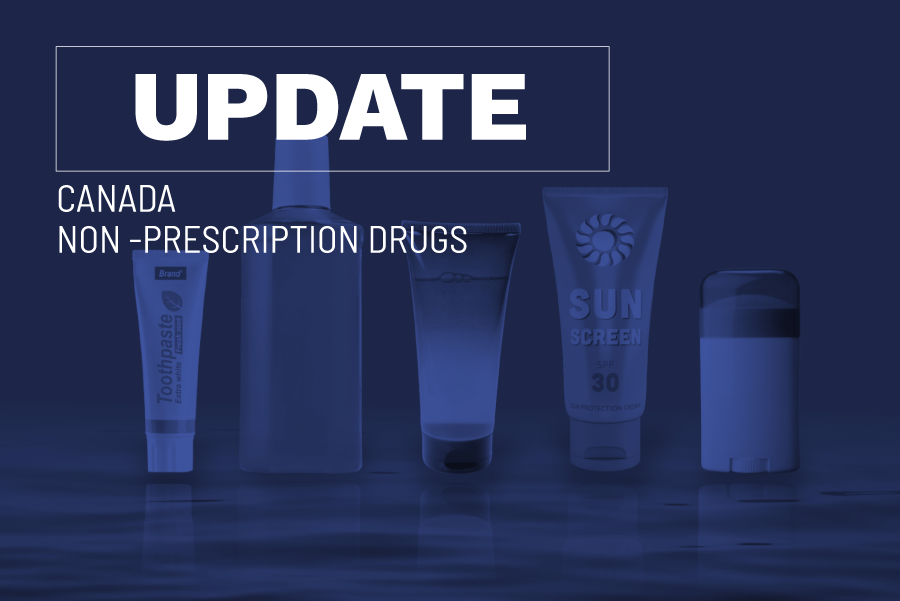
Health Canada is proposing a streamlined authorization pathway for certain low-risk non-prescription drugs in Canada. Eligible List D products that fully comply with an applicable Health Canada monograph could be exempted from Division 8 “new drug” requirements and instead apply for a Drug Identification Number (DIN) under Division 1. The proposal may affect products such as sunscreens, acne treatments, anti-dandruff products, antiperspirants, therapeutic oral care products, and medicated skin care products.
Understanding Health Canada’s Proposed Drug Pathway
Health Canada is proposing a temporary Ministerial Class Exemption Order that would create a streamlined authorization pathway of certain low-risk non-prescription drugs containing medicinal ingredients that are new to Canada. Under the proposed Ministerial Class Exemption Order, eligible products listed on Health Canada’s List D category framework could be exempted from the Division 8 “new drug” requirements of the Food and Drug Regulations, provided they fully comply with an applicable Health Canada monograph.
Qualifying products could instead apply for a Drug Identification Number (DIN) under Division 1 without requiring a Notice of Compliance (NOC). The proposal may be relevant to companies marketing products such as sunscreens, acne treatments, anti-dandruff products, antiperspirants, therapeutic oral care products (including toothpastes and mouthwashes), antiseptic skin cleansers, diaper rash products, medicated skin care products, throat lozenges, and athlete’s foot treatments.
However, the exemption is not yet in effect. Eligibility will depend on the final terms of the Ministerial Order, the applicable List D category, and the product’s full conformity with an eligible Health Canada monograph. The broader proposal to simplify Part C of the Food and Drug Regulations is expected to be published in the Canada Gazette, Part I, in fall 2027, when stakeholders and members of the public will have an opportunity to submit feedback on the proposed changes.
- What Is Health Canada's Proposed Division 8 Exemption?
- How Would the Proposed Division 1 DIN Pathway Work?
- How Do Health Canada Monographs Determine Eligibility?
- Division 1 Authorization and DIN Requirements
- Why Is Health Canada Proposing This Regulatory Change?
- How Could the Proposal Affect Sunscreens and Cosmetic-Like Drugs?
- What Products Will Not Qualify for the Streamlined Pathway?
- When Could the Proposed Exemption Take Effect?
- How Should Companies Prepare for the Proposed Pathway?
- Key Considerations for Industry
- FAQ About Health Canada's Proposed Division 8 Exemption
- Final Remarks
What Is Health Canada’s Proposed Division 8 Exemption?
Health Canada published a Notice of Intent (NOI) on May 15, 2026, outlining its plan to introduce a Ministerial Class Exemption Order for certain low-risk non-prescription drugs.

When Is a Product Considered a New Drug in Canada?
Under the current framework, a drug containing a medicinal ingredient that has not previously been authorized in Canada may be considered a “new drug.” This generally makes the product subject to Division 8 of Part C of the Food and Drug Regulations.

Why Does Division 8 Create Challenges for Low-Risk Drugs?
Division 8 can require a more extensive authorization process, even for drug products that may resemble low-risk consumer self-care products or cosmetic products in presentation or consumer use.
Health Canada identifies sunscreens, anti-dandruff products, and therapeutic oral care products as examples of products that may face the same new drug requirements as higher-risk prescription drugs.

Current Review Timelines and Costs
According to Health Canada, the current process may involve substantial data requirements, review timelines of up to 300 days, and substantial authorization costs.
The Department considers this burden disproportionate for lower-risk products intended for consumer self-selection and the treatment or prevention of common conditions.

How Would the Proposed Division 1 DIN Pathway Work?
The proposed exemption is intended to create a more proportionate authorization pathway while maintaining regulatory oversight for:
- Product authorization
- Safety and efficacy
- Quality
- Labelling
- Establishment licensing
- Good Manufacturing Practices (GMP)
The proposal would therefore simplify the applicable pre-market pathway for eligible products without removing their broader obligations under Canadian drug regulations.
Which Products Could Qualify for the Proposed Exemption?
The proposed exemption would apply only to low-risk non-prescription drug categories included on Health Canada’s List D.
These categories currently include:
- Acne therapy products
- Anti-dandruff products
- Antiperspirants
- Antiseptic skin cleansers
- Athlete’s foot treatments
- Diaper rash products
- Medicated skin care products
- Mouthwashes
- Sunscreens
- Throat lozenges
- Toothpastes
These products are generally used as part of routine self-care and are available without the intervention of a healthcare practitioner.
However, inclusion within a List D category would not automatically make a product eligible. The product would also need to meet every relevant parameter of an applicable Health Canada monograph.

How Do Health Canada Monographs Determine Eligibility?
Health Canada monographs establish standardized conditions for non-prescription drugs with well-characterized safety and efficacy profiles.
Depending on the product category, a monograph may define:
- Permitted medicinal ingredients
- Medicinal ingredient concentrations
- Dosage forms
- Routes of administration
- Acceptable indications and claims
- Directions for use
- Target populations
- Required warnings
- Contraindications
- Other conditions of use
How Monograph Compliance Supports Division 1 Authorization
Products that meet all applicable monograph parameters may qualify for authorization through the Division 1 DIN pathway without submitting independent evidence for every element of the product.
This approach allows Health Canada to rely on established conditions of use for lower-risk products with well-understood safety and efficacy profiles.
Can Products with New Medicinal Ingredients Use the Division 1 Pathway?
Where a product meets the definition of a new drug, authorization under Division 8 may be required even when the product resembles a low-risk non-prescription drug in another jurisdiction.
Will Health Canada Update Drug Monographs?
Health Canada intends to update its monographs over time and add new medicinal ingredients where appropriate.
These updates could allow more low-risk non-prescription drugs to use the Division 1 pathway instead of being regulated as new drugs under Division 8.
What Determines Eligibility for the Proposed Exemption?
The practical impact of the proposed exemption will depend on:
- Which monographs are updated
- Which medicinal ingredients are added
- The permitted concentrations
- The accepted claims and indications
- The allowable dosage forms
- The required warnings and conditions of use
Why List D Inclusion May Not Be Enough
A product could fall within a List D category and still remain ineligible for the exemption.
Eligibility would depend on the complete product profile, including its:
- Formulation
- Medicinal ingredient strength
- Claims
- Dosage form
- Route of administration
- Target population
- Directions for use
- Required warnings
Any material deviation from the applicable monograph could prevent the product from qualifying for the streamlined pathway.

Division 1 Authorization and DIN Requirements
The proposal would not eliminate the need for pre-market authorization. Sponsors of eligible products would still need to submit an application and obtain a DIN before selling the product in Canada. The difference is that the application could be reviewed under Division 1 rather than Division 8. A qualifying product could, therefore, receive a DIN without obtaining an NOC.
Products authorized through the proposed pathway would remain subject to the applicable drug requirements, including those related to:
- Product labelling, including Plain Language Labelling (PLL) where applicable
- Drug Establishment Licensing (DEL)
- GMP
- Manufacturing and importation
- Packaging and labelling activities
- Post-market compliance
- Safety reporting, where applicable
- Advertising and product representations
The proposed Order should not be interpreted as a general exemption from Canadian drug regulation. It would change the authorization pathway for eligible products, not their fundamental classification or ongoing regulatory obligations.

Why Is Health Canada Proposing This Regulatory Change?
Health Canada has identified regulatory, commercial, and public-health reasons for creating a more proportionate pathway.

Reducing Regulatory Burden for Low-Risk Drugs
Applying the full Division 8 framework to lower-risk, self-care products may create costs and evidence requirements that are disproportionate to their risk profile.
The exemption would allow qualifying products to rely on established monograph conditions while continuing to meet Canadian requirements for safety, efficacy, and quality.

Improving Access to New Non-Prescription Drugs
Some medicinal ingredients have established histories of use in foreign markets but have not been previously authorized in Canada.
The existing framework may make it difficult for companies to introduce these products, limiting the range of self-care options available to Canadian consumers.

Supporting International Regulatory Alignment
Health Canada has engaged with international partners, including the European Union through the Canada-European Union Regulatory Cooperation Forum, regarding barriers affecting lower-risk non-prescription drugs.
The proposal could facilitate the incorporation of internationally established ingredients into Canadian monographs where Health Canada determines that the supporting evidence is sufficient.

Diversifying Canada’s Drug Supply
Health Canada estimates that more than 70% of imports within the relevant product categories come from the United States.
The Department expects that improving access to products from a broader range of markets could increase consumer choice, support competition, and reduce reliance on a single source market. It may also create new domestic and export opportunities for Canadian manufacturers.

How Could the Proposal Affect Sunscreens and Cosmetic-Like Drugs?
The proposal may be particularly significant for products that fall near the boundary between cosmetics and drugs.
Products such as sunscreens, anti-dandruff shampoos, acne treatments, medicated skin care products, antiperspirants, and therapeutic oral care products may resemble cosmetics in their format, branding, or intended consumer use. However, when they contain medicinal ingredients or make therapeutic claims, they are regulated as drugs under the Food and Drug Regulations.
The proposed exemption would streamline the authorization pathway for certain eligible products but would not change their regulatory classification or ongoing compliance obligations.
What Does This Mean for Sunscreen Manufacturers?
For sunscreen companies, the proposal could eventually expand access to additional medicinal ingredients if Health Canada determines sufficient evidence exists and incorporates those ingredients into an applicable monograph.
However, the proposal does not immediately authorize sunscreen filters used in the U.S., Europe, Asia, or other international markets. Imported sunscreen products would still need to comply with the final conditions of the Ministerial Order, the applicable Health Canada monograph, and all Canadian regulatory requirements.
Companies should therefore avoid assuming that internationally marketed sunscreen formulations can enter the Canadian market without changes to their formulation, claims, testing, packaging, or labelling.

What Products Will Not Qualify for the Streamlined Pathway?
The proposed exemption is fundamentally a conformity-based pathway.
Products that deviate from an applicable monograph may not qualify. Potential deviations include:
- An unlisted medicinal ingredient
- A concentration outside the permitted range
- A new combination of medicinal ingredients
- A novel dosage form
- A different route of administration
- Claims not supported by the monograph
- Different directions or duration of use
- A different target population
- Modified warnings or contraindications
Depending on the deviation, the company may need to revise the product or pursue another authorization route supported by additional evidence.
This distinction is important for innovative products. A product may be low risk from a commercial or scientific perspective but still fall outside the exemption if it does not meet the precise regulatory conditions.

When Could the Proposed Exemption Take Effect?
The exemption is not yet available. Health Canada accepted stakeholder comments and supporting evidence until July 14, 2026, including information on medicinal ingredients used in foreign List D products that could inform future updates to Canadian monographs.
Until the Ministerial Order is formally published, companies must continue to assess and authorize products under the existing Food and Drug Regulations. The final Order may also include eligibility criteria, definitions, limitations, or transition provisions that were not fully set out in the NOI.
The Order Is Intended as an Interim Measure
Health Canada intends the exemption to operate only until the broader Simplifying Part C of the Food and Drug Regulations initiative comes into force. Once that modernization is implemented, the Ministerial Order would be repealed.
Companies planning longer-term product portfolios should therefore monitor both the proposed exemption and the broader Part C modernization, as the future regulatory pathway may evolve beyond the temporary Order.

How Should Companies Prepare for the Proposed Pathway?
Companies developing or importing low-risk non-prescription drugs can begin evaluating whether their products may benefit from the proposed exemption.

Confirm the Correct Product Classification
Determine whether the product is regulated as a non-prescription drug, cosmetic, natural health product, medical device, or another product type.
Classification may be influenced by the ingredients, claims, composition, format, route of administration, and overall product representation.

Identify the Applicable List D Category
Confirm whether the product falls within one of the categories Health Canada has identified as eligible for the proposed exemption. .

Review the Applicable Health Canada Monograph
Compare the product against all relevant monograph requirements, including its medicinal ingredients, concentrations, claims, warnings, directions, dosage form, route of administration, and target population.

Identify Regulatory Gaps
Document any areas where the product falls outside the monograph. This can help determine whether the formulation or positioning could be adjusted or whether another regulatory pathway may be required.
Assess the Supporting Evidence
For medicinal ingredients that are not currently included in a Health Canada monograph, review the available:
- Foreign regulatory decisions
- Safety data
- Clinical evidence
- Quality information
- Market history
- Conditions of use
Strong foreign evidence may support future monograph development but does not replace the requirement for Canadian authorization.
Review Licensing and GMP Requirements
A streamlined product authorization pathway would not eliminate the need for compliant manufacturing, packaging, labelling, testing, importation, or distribution activities.
Where required under the Food and Drug Regulations, companies should confirm that all relevant parties are appropriately qualified and licensed before market entry.
Avoid Relying on the Proposal Before It Is Final
Until the final Ministerial Order is published, businesses should avoid basing production schedules, packaging orders, retailer commitments, or Canadian launch dates solely on the proposed exemption.

Key Considerations for Industry
Health Canada’s proposed Division 8 exemption could provide a more practical route to market for certain low-risk non-prescription drugs, particularly where the medicinal ingredients have established safety and efficacy profiles in other jurisdictions.
However, the proposal is narrower than a general authorization of foreign products or ingredients.
Eligibility would require:
- Inclusion within a List D product category
- Full compliance with an applicable Health Canada monograph
- A successful Division 1 DIN application
- Continued compliance with drug labelling, licensing, quality, and GMP requirements
- Adherence to any additional conditions in the final Ministerial Order
Early regulatory assessment will be important. Companies should determine not only whether a product is considered low risk, but whether its complete formulation, claims, packaging, and conditions of use align with the proposed pathway.

Final Remarks
The proposed Ministerial Order could reduce unnecessary barriers for certain low-risk non-prescription drugs while maintaining Canadian requirements for product authorization, safety, quality, and regulatory oversight.
The pathway may create new opportunities, but its commercial usefulness will depend on the final Order, future monograph updates, and the degree to which individual products can conform to the applicable requirements.
How SNI Helps Companies Prepare for Canada’s Proposed Drug Pathway
Source Nutraceutical, Inc. (SNI) supports companies developing and marketing non-prescription drugs, cosmetics, natural health products (NHPs), and other self-care products in Canada. Our team can assist with product classification, monograph assessments, formulation gap reviews, DIN applications, label and claims compliance, DEL strategy, and Canadian market-entry planning.
An early assessment can help determine whether a product may qualify for the proposed exemption, what changes could be required, and which regulatory pathway provides the most practical route to the Canadian market.

Book an introductory call using the following form:
FAQ About Health Canada’s Proposed Division 8 Exemption
Is Health Canada eliminating Division 8 for non-prescription drugs?
No. The proposal would create a targeted exemption for eligible low-risk non-prescription drugs included on List D and compliant with an applicable Health Canada monograph. Division 8 would continue to apply to other new drugs.
Would eligible products still require a DIN?
Yes. Sponsors would still need to apply for and receive a Drug Identification Number (DIN) before selling the product in Canada.
Are all List D products automatically eligible?
No. The product would also need to comply fully with an applicable monograph and meet the final conditions of the Ministerial Order.
Is the proposed exemption currently in effect?
No. Health Canada has published a Notice of Intent (NOI), but the Ministerial Class Exemption Order must still be formally published before the pathway becomes available.
The content on this website, including information presented in this post, is provided for general informational purposes only and does not constitute legal, regulatory, or professional advice. While efforts are made to ensure accuracy, laws and regulations vary by jurisdiction and may change over time. Readers should not rely on this information as a substitute for advice from qualified legal or regulatory professionals. We disclaim any liability for actions taken based on this content, and users are encouraged to seek guidance specific to their circumstances.