
Pet food traceability is not universally mandated in Canada. Unlike food intended for human consumption, conventional dog and cat food is not subject to a comprehensive federal traceability framework. However, certain obligations may apply under the Health of Animals Act and Health of Animals Regulations, particularly for products containing animal-origin ingredients and those intended for import or export.
Within this framework, the Canadian Food Inspection Agency (CFIA) primarily oversees pet food in relation to animal health and import/export requirements. Manufacturers, importers, and pet food brands must therefore assess their products and activities to determine which documentation, identification, and regulatory obligations apply.
Beyond mandatory requirements, maintaining supplier records, production lot identification, and distribution documentation supports product safety, supply chain accountability, and effective recall management. Understanding where regulatory obligations end and industry best practices begin is essential to establishing a practical, reliable traceability system.
Pet food traceability is the ability to identify and follow ingredients, materials, and finished products throughout the supply chain, from initial sourcing through manufacturing and distribution. In practice, an effective system allows businesses to determine where ingredients originated, which production batches contain them, and where affected products were distributed.
Ingredient traceability establishes a documented connection between suppliers, incoming materials, and finished products. For pet food manufacturers, this may include supplier identification, ingredient specifications, certificates of analysis, receiving dates, and supplier lot numbers. These records are particularly valuable for products containing ingredients of animal origin, where sourcing and processing conditions may affect import eligibility and animal health risks.
Building on supplier records, production traceability links individual batches to their formulations, processing dates, ingredients, and manufacturing conditions. Assigning identifiable production lots allows manufacturers to investigate quality concerns without treating every unit of a product as potentially affected.
Once those batches leave the manufacturing facility, distribution traceability identifies where finished products were shipped, including quantities, shipment dates, distributors, and retail destinations. Together, ingredient, production, and distribution records allow businesses to trace potentially affected products backward to their source and forward through the supply chain.
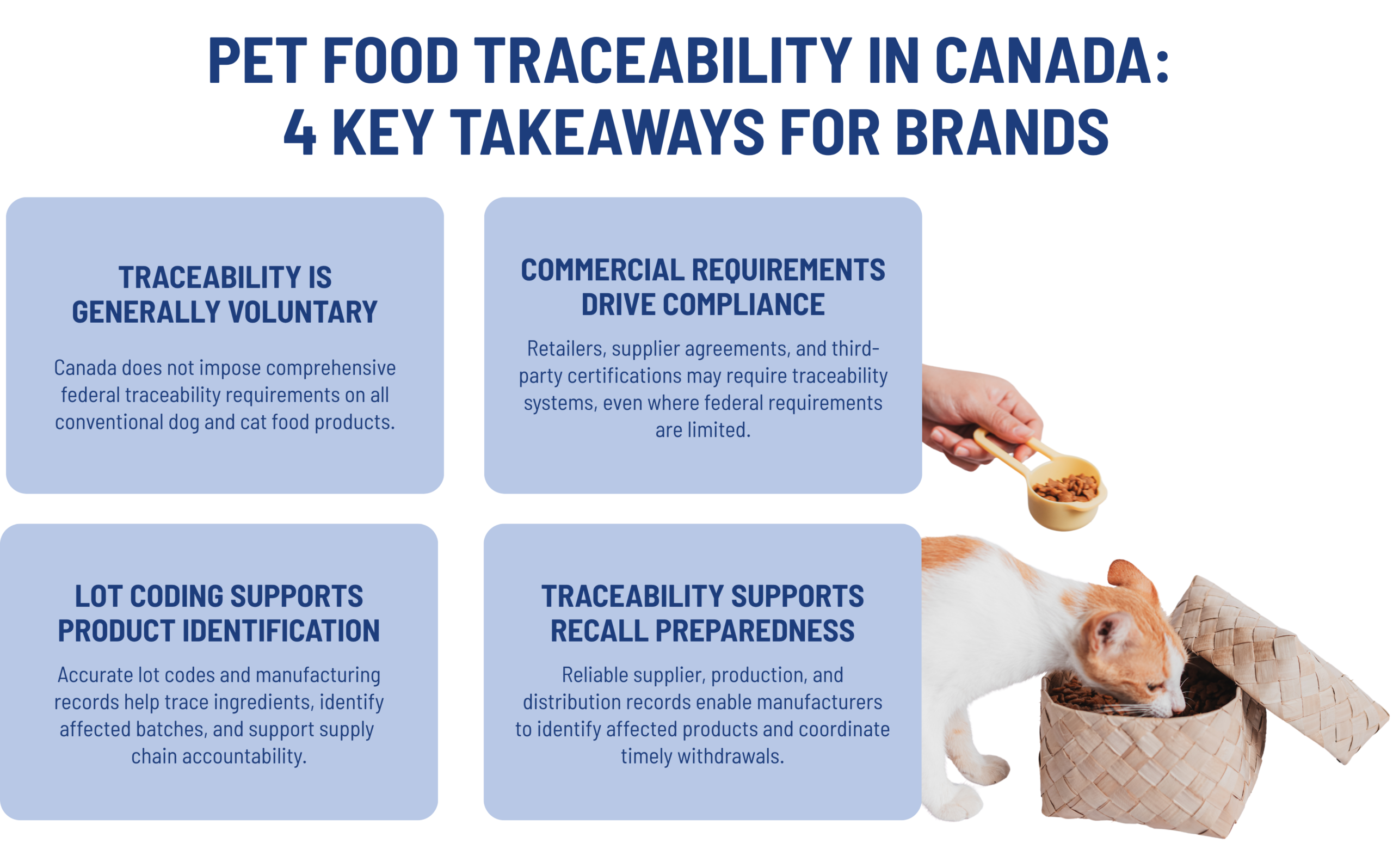
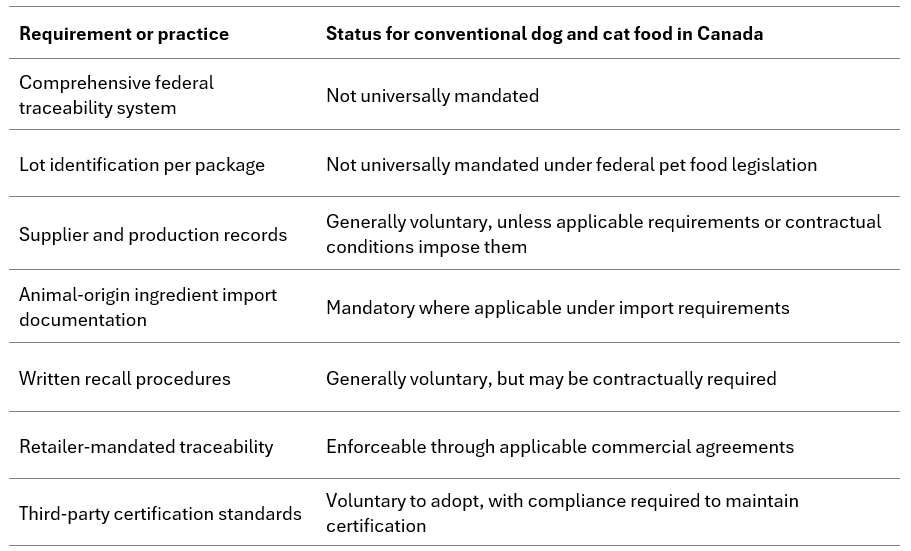
Comprehensive traceability systems are generally voluntary for conventional dog and cat food in Canada. Whether a particular business must maintain traceability records depends on its regulatory obligations and commercial agreements. Retailers, distributors, and private-label partners may require lot identification, supplier documentation, and recall procedures as conditions of doing business.
Voluntary traceability does not mean an absence of regulatory accountability. Applicable animal health, consumer protection, and product-specific legislation remains enforceable by the responsible authorities.
Government oversight differs from these commercial expectations. The CFIA's authority over conventional pet food primarily concerns imports and exports of animal products and by-products to prevent the introduction and spread of animal diseases.
Domestic pet food manufacturing and sale are not subject to a comprehensive federal regulatory framework administered by the CFIA. However, other federal legislation may apply depending on the product's ingredients, intended use, and representations.
Within this animal health mandate, the Health of Animals Act and Health of Animals Regulations establish requirements that may affect pet foods containing animal-origin materials, particularly those imported into Canada.
Depending on the product and country of origin, these requirements may include import permits, veterinary certification, approved manufacturing establishments, and supporting documentation.
Not all provisions of the Health of Animals Regulations apply to pet food. Section 171, for example, establishes specific production records and ten-year retention requirements for animal food intended for designated livestock and poultry species. Those requirements do not apply to conventional dog and cat food.
Other federal frameworks also distinguish pet food from human food and livestock feed. The Safe Food for Canadians Regulations (SFCR) establish traceability requirements for regulated human food businesses, while the Feeds Act and Feeds Regulations, 2024 govern livestock feeds.
Neither framework should be interpreted as establishing universal traceability obligations for conventional pet food.
Nevertheless, pet food businesses may be subject to other federal and provincial requirements, including applicable animal health, import, consumer packaging, and advertising legislation.
Where traceability is not legally prescribed, commercial agreements and certification standards can create accountability.
Supplier agreements, customer audits, and contractual remedies can enforce these expectations. Third-party certification programs may also assess traceability and recall preparedness as conditions of maintaining certification. These mechanisms complement rather than replace government oversight.
Manufacturers should tailor their records to the product's composition, manufacturing processes, distribution channels, and applicable regulatory and commercial requirements. Where recordkeeping is voluntary, the documentation still supports quality assurance and recall preparedness.
Manufacturers should record ingredient suppliers, incoming material specifications, receiving dates, and lot numbers to establish ingredient origins and link shipments to finished products.
To carry supplier information through manufacturing, production documentation should link raw material lots to finished-product batches. This may include formulation records, manufacturing dates, batch quantities, quality control results, and assigned lot numbers.
A consistent lot identification system allows manufacturers to isolate potentially affected products rather than unnecessarily expanding the scope of a withdrawal.
The next link is distribution: records should identify customers, shipment dates, product quantities, and associated lot numbers.
For businesses operating through contract manufacturers, distributors, or third-party logistics providers, clear documentation and defined responsibilities are particularly important to maintaining traceability across the supply chain.
Lot coding connects these records to products manufactured under defined production conditions. While a universal lot coding requirement does not apply to all conventional pet foods in Canada, it remains an important component of effective traceability and recall management.
Lot numbers allow manufacturers to distinguish between production batches and retrieve the records associated with each finished product.
For example, if a supplier identifies contamination in a particular ingredient shipment, batch records can help determine which finished products contain the affected material.
For lot numbers to serve this purpose beyond the facility, printed codes should be legible, durable, and positioned where consumers and supply chain partners can readily identify them.
Packaging design should account for the intended coding method, packaging material, available print area, and potential impacts of handling or storage.
Code type matters too: a Universal Product Code (UPC) identifies a product for commercial purposes, while a lot number identifies a specific production batch. They are not interchangeable.
Printed codes are only useful when they link to accessible records. Businesses should establish procedures for tracing each lot to its ingredients, production information, and shipments, enabling timely investigations and targeted corrective actions.
For imported pet food, recordkeeping must also account for applicable import controls, particularly for animal products or by-products. Requirements vary by composition, country of origin, manufacturing establishment, and processing method. Unlike domestic manufacturing, commercial imports of pet food containing animal-origin ingredients fall within the CFIA's animal health oversight.
Under the Health of Animals Regulations, the CFIA establishes import conditions intended to prevent the introduction of animal diseases into Canada.
These controls may apply to products such as dry kibble, canned pet food, raw diets, freeze-dried products, and pet treats containing animal-origin ingredients (i.e., fish oil, gelatin, and other animal by-products).
The applicable conditions depend on the product and origin. Manufacturers should not assume that approval of one formulation, processing method, or manufacturing establishment automatically extends to other products.
Under the CFIA's current policy, commercial shipments of pet food containing animal-origin ingredients must be accompanied by a zoosanitary certificate. An import permit and facility questionnaire may also be required, depending on the exporting country and establishment approval arrangements.
Importers should verify the applicable requirements through the CFIA Automated Import Reference System (AIRS) before arranging shipments. A generic AIRS search for ‘pet food’ may not be sufficient to establish import eligibility, and this search must be assessed for the specific ingredients, processing method, and country of origin.
For exports, Canadian manufacturers must assess destination-country requirements, which may include establishment approvals, veterinary certification, ingredient restrictions, and product-specific documentation. Maintaining accurate manufacturing and traceability records can help businesses demonstrate product origin and satisfy applicable export certification requirements.
Whether products are sold domestically or abroad, traceability helps businesses identify and remove affected products when contamination, ingredient defects, formulation errors, or manufacturing deviations arise.
Documented recall procedures turn that information into a coordinated response, helping manufacturers and brand owners limit the scope of a withdrawal and meet applicable commercial and regulatory obligations.
Ingredient and production records identify which batches may be affected by a safety issue. Without reliable links between them, businesses risk expanding the scope and cost of a withdrawal.
Once potentially affected lots have been identified, distribution records allow manufacturers to determine which commercial customers received them, including relevant quantities and shipment dates.
For private-label pet food brands, coordination with contract manufacturers and distribution partners is particularly important. Responsibilities for maintaining records, investigating complaints, and communicating product concerns should be clearly established.
To coordinate these identification and communication tasks, a documented recall procedure should identify responsible personnel, communication channels, product identification methods, and the steps required to investigate and manage affected products.
Periodic mock recalls can help businesses evaluate the effectiveness of these procedures, identify documentation gaps, and confirm that affected production lots can be traced through distribution.
To see how these elements work together, consider a pet food manufacturer that receives notification of potential Salmonella contamination in a shipment of poultry meal. The manufacturer must determine whether the affected ingredient was used in production, which finished-product lots contain it, and where those products were distributed.
Linked supplier, production, and distribution records allow the manufacturer to isolate affected lots and coordinate corrective action. Gaps in those links can lead to broader withdrawals, higher costs, and longer investigations.
As the above example shows, effective traceability depends on connected records, not necessarily complex software. Manufacturers and brand owners can build those connections into existing quality assurance, supplier management, and packaging processes.
Supplier agreements and quality procedures should specify which documentation responsibilities belong to ingredient suppliers, contract manufacturers, and logistics providers. These responsibilities should cover lot identification, record access, retention, and communication during investigations.
Packaging should carry these practices through to the finished product with consistent information and legible lot codes.
In addition to traceability considerations, pet food labels must comply with applicable Canadian legislation, including the Consumer Packaging and Labelling Act and Competition Act.
The Competition Bureau's Guide for the Labelling and Advertising of Pet Foods provides industry guidance for prepackaged dog and cat food (excluding pet treats or foods for other pets), addressing ingredient declarations, nutritional information, product representations, and labelling practices. The guide distinguishes mandatory legal requirements from recommended practices. Read our Pet Food Labelling Guide to learn more.
Once these practices are in place, periodic mock recalls can test record completeness and accessibility, revealing inconsistent lot codes, missing supplier information, or gaps between manufacturing and distribution records.
Addressing these issues before an incident occurs supports more efficient investigations and reduces the likelihood of avoidable disruptions.
Manufacturers and importers should first assess applicable animal health, import, labelling, and product-specific requirements, then maintain linked supplier, production, and distribution records. Together, regulatory compliance and these practical supply chain controls support product safety and recall preparedness.
Navigating Canadian pet food requirements involves more than understanding which regulations apply. Manufacturers, importers, and brand owners must also consider ingredient compliance, product classification, import documentation, labelling, and the traceability practices necessary to support product safety and market readiness.
With more than 22 years of industry experience, Source Nutraceutical, Inc. (SNI) provides regulatory consulting and creative services to help pet food businesses address these requirements throughout product development and commercialization. Our multidisciplinary team supports regulatory assessments, ingredient and label reviews, and packaging development, helping brands identify compliance considerations before they become costly obstacles.
Whether you are introducing a new pet food product, importing an established formulation, or expanding your product portfolio, SNI can help you navigate the Canadian regulatory landscape with confidence.
Contact our regulatory specialists to discuss your pet food compliance and market-entry needs.