Energy drinks have become one of the most visible beverage categories in Canada, driven by new flavours, functional positioning, and growing consumer demand for products associated with energy, focus, and performance. Yet despite strong consumer demand, many brands enter the market without a regulatory and commercialization strategy designed for long-term success.
One of the most important considerations for brands and manufacturers launching a new formulation is the level of regulatory oversight in the target jurisdiction. This is particularly true in Canada, where many energy drinks are regulated differently than conventional foods. Even with specialized requirements, energy drinks remain a high-growth product category, provided compliance is built into the launch plan from the start.
This article explains how energy drinks are regulated in Canada, including key classification issues, ingredient and formulation constraints, labelling and claims requirements, and common pitfalls that delay launch.
- Energy Drinks Under the Food and Drugs Act and Food and Drug Regulations
- Determining Whether Your Energy Drink Meets Canada’s Supplemented Food Definition
- Ingredient and Formulation Requirements for Energy Drinks Sold in Canada
- Permitted Ingredients for Energy Drinks Sold in Canada
- Core Labelling Requirements for Energy Drinks in Canada
- Claims and Marketing Language for Energy Drinks Sold in Canada
- Common Pitfalls That Delay Energy Drink Launches in Canada
- Six-Step Compliance Checklist for Launching Energy Drinks in Canada
- How SNI Supports Energy Drink Compliance and Launch in Canada
- Final Remarks
- FAQ
Energy Drinks Under the Food and Drugs Act and Food and Drug Regulations
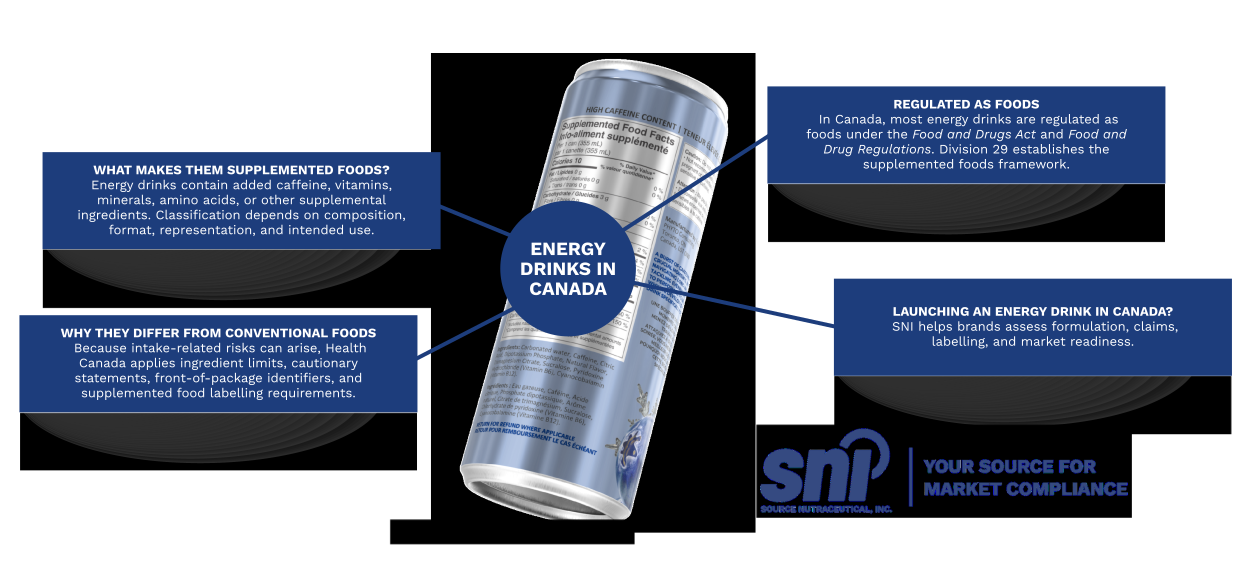
In Canada, energy drinks are regulated as foods under the Food and Drugs Act and the Food and Drug Regulations. Most caffeinated energy drinks are subject to Division 29 of the Food and Drug Regulations, which establishes the supplemented foods framework for prepackaged foods containing added supplemental ingredients (SIs) such as caffeine, vitamins, minerals, or amino acids. Health Canada identifies caffeinated energy drinks as a common example of supplemented foods and restricts caffeine from all sources to 180 mg per serving for caffeinated energy drinks.
What Makes an Energy Drink a Supplemented Food in Canada?
Most energy drinks fall within Canada’s supplemented foods framework because they are formulated with added caffeine, vitamins, minerals, amino acids, or other SIs that are intended to provide effects beyond basic nutrition. Classification is assessed based on the product’s composition, format, representation, and intended use, rather than the product name alone.
Where SIs are present, each ingredient must be permitted by Health Canada and used in accordance with the applicable conditions of use. This includes any category restrictions, maximum amounts, cautionary statement triggers, and prescribed labelling requirements that apply to the finished product as consumed.
Why Energy Drinks Are Different from Conventional Foods
Energy drinks require a higher level of regulatory oversight than conventional beverages because their ingredients and consumption patterns can raise intake-related concerns. Caffeine, B vitamins, minerals, taurine, and similar SIs may be safe under defined conditions but can create compliance issues when used at excessive levels, combined with other supplemented ingredients, or marketed in a way that encourages frequent consumption. Health Canada’s supplemented foods framework is designed to manage these risks through ingredient limits, cautionary statements, front-of-package identifiers, and supplemented food labelling requirements.

Determining Whether Your Energy Drink Meets Canada’s Supplemented Food Definition
Once it is established that an energy drink may fall within the supplemented foods framework, the next step is to confirm whether the specific product meets Canada’s supplemented food definition. This assessment should be completed before formulation is finalized, labels are developed, or commercialization planning begins, because similar beverage products can be regulated differently depending on how they are formulated, positioned, and intended to be consumed.
The assessment should move beyond the general product category and consider how Health Canada is likely to evaluate the product in practice. For energy drinks, this typically involves four core classification factors: ingredient profile, product format, intended use, and claims.
Ingredient Profile and Supplemental Ingredients (SIs)
Ingredient composition is usually the starting point. The type and level of caffeine, vitamins, minerals, amino acids, botanicals, or other SIs included in the formulation must align with permitted uses and applicable conditions. Even small deviations in ingredient level, source, or combination can affect whether the product fits within the supplemented foods framework.
Product Format and Conditions of Use
Format plays an important role in classification. A ready-to-drink beverage intended for general consumption is more likely to align with a food-based framework, while concentrated formats, shots, powders, or products with directed-use patterns may raise additional classification considerations. Format also affects how serving size, intake limits, cautionary statements, and label presentation should be assessed.
Intended Use and Consumer Positioning
Intended use is shaped by how the product is represented to consumers. A beverage positioned for routine consumption may be assessed differently from a product promoted for a specific functional purpose. Where the presentation suggests targeted stimulation, performance enhancement, cognitive support, or another defined physiological effect, the product may require closer review to confirm that it remains within the appropriate food-based pathway.

Claims and Marketing Language
Claims are often one of the most decisive classification factors. Energy drink claims must be carefully reviewed to ensure they remain consistent with the product’s regulatory status and do not create a therapeutic or otherwise unsuitable positioning. Performance, alertness, endurance, focus, or cognitive claims may carry different regulatory implications depending on wording, context, substantiation, and how they interact with the overall product presentation.
Where these factors align with the supplemented foods framework, the product may proceed as a supplemented food, provided it also meets all applicable requirements before market entry. For energy drinks, this includes confirming that the product falls within the permitted supplemented food categories and complies with Health Canada’s ingredient-specific conditions, caffeine limits, cautionary statements, labelling requirements, and marketing restrictions.

Ingredient and Formulation Requirements for Energy Drinks Sold in Canada
Due to the presence of SIs, energy drinks must comply Canada’s supplemented foods framework at both the ingredient and finished product level. Only ingredients that appear on the List of Permitted Supplemental Ingredients (the List) may be used, and each must comply with its defined conditions, including maximum levels and any required labelling statements.
Caffeine Limits for Energy Drinks in Canada
Caffeine is one of the most important compliance considerations for energy drink formulations because Canadian requirements apply to the total caffeine content from all sources. This includes caffeine that is directly added, as well as caffeine naturally contributed by ingredients such as guarana, yerba mate, tea, coffee, cocoa, or other botanical sources.

Caffeine Sources and Caffeine-Containing Ingredients
The caffeine source itself must also be acceptable under the supplemented foods framework and align with the List, including any applicable conditions attached to its use. Where caffeine-enriched extracts or other caffeine-containing preparations are used, the preparation should be assessed to confirm that it does not introduce ingredients, additives, carriers, solvents, or substances that are not acceptable for use in foods sold in Canada.
High Caffeine Energy Drinks and Mandatory Cautionary Statements
Products containing more than 150 ppm and up to 400 ppm of caffeine are subject to a more restrictive compliance tier. These products must not provide more than 180 mg of caffeine per serving and must include the required “high caffeine content” statement.
They must also carry mandatory cautionary statements for children, pregnant or breastfeeding individuals, and individuals who are sensitive to caffeine. Where the declared caffeine content exceeds 79 mg per serving, an additional intake statement is required to help ensure total daily caffeine consumption does not exceed 400 mg.
From a formulation and label development perspective, the full caffeine contribution from all sources must be calculated, substantiated, and reflected accurately against the applicable Canadian thresholds before the product is brought to market.

Permitted Ingredients for Energy Drinks Sold in Canada
Ingredient eligibility should be confirmed before the formulation is finalized. For energy drinks, SIs must appear on the List and be used within the conditions attached to that ingredient, including any limits, category restrictions, cautionary statement triggers, or required label text.
Common ingredients in this space may include vitamins, mineral nutrients, amino acids, and certain herbal extracts. However, permitted use is not uniform across all energy drink formats. Caffeine content can narrow the available formulation range, reducing the permitted levels of certain vitamins in higher-caffeine products.
Ingredients That May Require Additional Regulatory Review
Ingredients that are absent from the List, used outside their permitted conditions, or potentially novel should be reviewed before commercialization planning advances. These ingredients may require additional substantiation, a novel food assessment, reformulation, or a different regulatory strategy.
This is where early formulation review becomes commercially important. Identifying non-permitted ingredients, excessive dosing, or unsuitable ingredient combinations before artwork, import documentation, or retailer discussions begin can help avoid avoidable delays, relabelling, reformulation, or pathway changes.

Core Labelling Requirements for Energy Drinks in Canada
Another key aspect of the supplemented food regulations is the implementation of the Supplemented Food Facts table (SFFt), the Supplemented Foods Caution Identifier (SFCI) and caution statements. These label elements help differentiate supplemented foods from conventional foods, which instead use the standardized Nutrition Facts table (NFt).
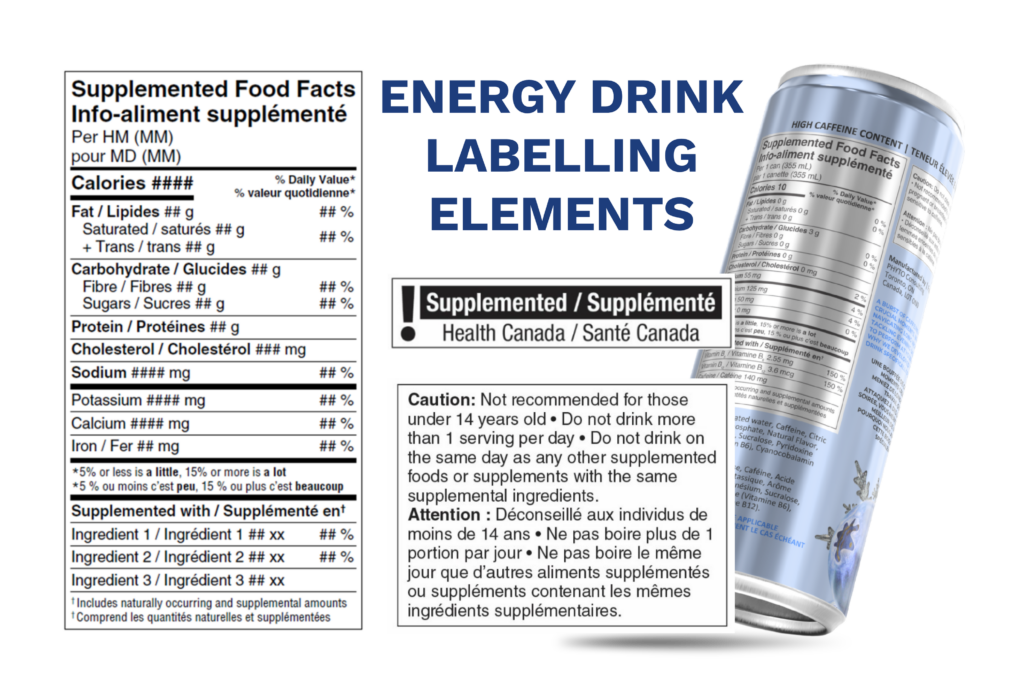
Supplemented Food Facts Table (SFFt) for Energy Drinks in Canada
Supplemented energy drinks must display a standardized SFFt that corresponds to the size of the principal display surface (PDS). While similar in structure to a traditional NFt, the SFFt includes additional information specific to supplemented ingredients.
The key distinction is the inclusion of a “Supplemented with” section, which identifies added SIs, their amounts and, where applicable, their % Daily Value. The table is labelled as “Supplemented Food Facts” rather than “Nutrition Facts” and must be presented in both English and Canadian French to meet regulatory requirements.
Supplemented Foods Caution Identifier (SFCI) for Energy Drinks in Canada
Where caffeine or other ingredients trigger a cautionary statement, the SFCI must appear on the principal display panel (PDP). It must follow strict formatting, placement, and bilingual requirements, and cannot be used voluntarily.
Learn more about Supplemented Food Labelling and SFCI requirements in our in-depth article: Canada’s Supplemented Food Labelling and Regulations

Claims and Marketing Language for Energy Drinks Sold in Canada
Claims for energy drinks must remain consistent with a food-based regulatory pathway. For supplemented foods, the product name, label text, website copy, social media content, sales materials, and advertising should support the intended classification and avoid positioning the product as therapeutic, disease-related, or suitable for use in a manner that conflicts with its caffeine-related conditions of use.
Lower-Risk Claims for Energy Drinks
Lower-risk claims generally focus on taste, flavour, refreshment, serving format, lifestyle context, or factual ingredient presence, provided the statements are accurate, substantiated, and not misleading. References to flavour profile, carbonation, sugar content, or the presence of permitted ingredients may be acceptable where they do not imply a specific physiological effect or create a functional product positioning.
Higher-Risk Energy Drink Claims
Regulatory risk increases when claims suggest measurable effects on focus, alertness, endurance, physical performance, metabolism, mood, or other physiological functions. Claims that imply enhanced energy beyond ordinary food consumption, improved cognitive performance, or targeted functional benefits may create classification concerns, particularly where the overall presentation suggests the product is intended to produce a defined physiological outcome.
Claims Not Permitted on High-Caffeine Energy Drinks
Energy drinks that are required to carry the “high caffeine content” statement are subject to additional restrictions under the Food and Drug Regulations. These products cannot make express or implied representations about vitamins or mineral nutrients contained in the supplemented food, whether on the label or in advertising. This restriction helps prevent high-caffeine products from being positioned as suitable for routine, long-term consumption as part of a daily eating pattern.
Vitamins and mineral nutrients may still be declared where required, including in the ingredient list, SFFt or other prescribed label components. However, they should not be promoted as a benefit of consuming the product.

High-caffeine energy drinks must also avoid physical performance claims, including claims related to endurance, recovery, power, strength, sports performance, or use before, during, or after physical activity. Claims suggesting hydration or electrolyte replacement, including statements such as “with electrolytes,” may also be unsuitable where they imply that a high-caffeine product can be used for hydration support.
For this reason, claims review should extend beyond the product label. Front-of-pack callouts, flavour names, website copy, social media posts, sell sheets, retailer materials, and advertising should all be assessed to ensure the product’s positioning remains aligned with Canada’s supplemented foods framework.

Common Pitfalls That Delay Energy Drink Launches in Canada
Despite a defined regulatory framework, energy drink launches are often delayed by avoidable compliance gaps. These issues typically arise from misalignment between formulation, labelling, and product positioning, and are often identified during internal review, retailer onboarding, or post-market oversight rather than through a formal submission process.
Misclassification Leading to Reformulation or Re-Submission
An incorrect classification at the outset can disrupt the entire market entry strategy. If a product is later determined to fall outside the intended framework, it may require reformulation, relabelling, or re-assessment under a different regulatory pathway, significantly extending timelines.
Use of Non-Permitted Ingredients or Incorrect Levels
Formulations that include ingredients not listed on Health Canada’s permitted lists, or that exceed established limits, are a frequent source of delay. Even minor deviations from ingredient conditions of use can result in non-compliance and require corrective action before launch.
Labelling Deficiencies, Especially Cautionary Statements
Energy drinks are subject to specific labelling requirements, particularly where caffeine triggers risk statements. Missing, incorrect, or improperly formatted cautionary statements, including the absence of the SFCI, when required, can prevent products from entering the market.
Claims That Exceed What Is Permitted for Foods
Overstated or improperly framed claims can shift how a product is regulated. Claims suggesting performance, cognitive, or physiological benefits may fall outside what is permitted under food frameworks, creating reclassification risk and potential enforcement issues.

Six-Step Compliance Checklist for Launching Energy Drinks in Canada
Launching a compliant energy drink in Canada requires a structured regulatory review before the product reaches market. Companies should assess the product’s classification, formulation, labelling, claims, and supporting documentation against Health Canada’s supplemented foods requirements.

Confirm Product Classification
Evaluate the ingredient profile, product format, intended use, and claims to confirm whether the product fits within Canada’s supplemented foods framework.

Verify Ingredient Eligibility
Review all ingredients and levels against Health Canada’s List of Permitted Supplemental Ingredients and any applicable ingredient-specific conditions of use.

Calculate Total Caffeine Content
Determine total caffeine from all sources, including added and naturally occurring caffeine, to confirm compliance with applicable limits and identify any required cautionary statements..

Build Required Label Elements
Prepare the SFFt, SFCI, cautionary statements, and other required bilingual label elements.

Review Claims and Marketing Language
Assess label claims, front-of-pack statements, website copy, social media content, sales materials, and advertising for accuracy, substantiation, and alignment with the intended regulatory pathway.

Conduct Final Pre-Launch Verification
Complete a final review of the formulation, label artwork, claims, import documentation, and compliance records before market entry.

How SNI Supports Energy Drink Compliance and Launch in Canada
Planning to launch an energy drink in Canada? SNI can help you confirm the correct regulatory pathway, assess your formulation against Canada’s supplemented foods requirements, review claims and labelling, and identify compliance gaps before they delay commercialization. Contact SNI to support a smoother, more strategic Canadian market entry.
Final Remarks
For energy drink brands entering Canada, regulatory alignment is a foundational part of commercialization. The supplemented foods framework affects formulation, claims, labelling, packaging, import planning, and how the product can be positioned in market.
Addressing these requirements early helps reduce avoidable delays, prevent costly label or formulation revisions, and protect brand credibility with regulators, retailers, and consumers. A compliant product is easier to launch, easier to scale, and better positioned for long-term market success.
Working with an experienced regulatory partner can help companies identify the right pathway, resolve compliance issues early, and move toward launch with a stronger commercial foundation.
FAQ
Are energy drinks regulated as natural health products (NHPs) in Canada?
Most energy drinks are regulated as supplemented foods, not NHPs, when they are sold as conventional beverage-style products with added caffeine or other supplemental ingredients. Classification depends on the product’s format, composition, claims, and intended use.
What is the maximum caffeine limit for energy drinks in Canada?
Caffeinated energy drinks in Canada are subject to maximum caffeine limits, including a maximum of 180 mg of caffeine per serving from all sources. Additional concentration limits and labelling requirements may apply depending on the total caffeine level in the finished product as consumed.
Do energy drinks need pre-market approval in Canada?
Energy drinks that comply with Canada’s supplemented foods framework generally do not require product-by-product pre-market approval. However, a pre-market submission may be required if the product uses an ingredient, level, category, or condition of use that is not already permitted under Health Canada’s incorporated lists.
What claims are allowed on energy drink labels in Canada?
Energy drink claims in Canada must be truthful, substantiated, and consistent with the product’s classification as a supplemented food. Claims must not create a therapeutic positioning, imply disease treatment or prevention, or encourage use patterns that conflict with caffeine-related cautionary statements or conditions of use.
Can I import energy drinks into Canada without a licence?
Importers may require a Safe Food for Canadians (SFC) licence to import energy drinks for commercial sale in Canada. Before import, companies should confirm that the product meets Canadian formulation requirements, bilingual labelling rules, supplemented foods requirements, and applicable food safety obligations.
The content on this website, including information presented in this post, is provided for general informational purposes only and does not constitute legal, regulatory, or professional advice. While efforts are made to ensure accuracy, laws and regulations vary by jurisdiction and may change over time. Readers should not rely on this information as a substitute for advice from qualified legal or regulatory professionals. We disclaim any liability for actions taken based on this content, and users are encouraged to seek guidance specific to their circumstances.