


visit sniclinic dot com here

Brand Refreshes for Regulated Products: How to Rebrand Without Triggering Regulatory Re-Review

From a commercial perspective, rebranding a regulated product can appear straightforward. A company may want to modernize its packaging, introduce a new visual identity, update a product name, or refresh how it positions the product for consumers. However, proposed changes can have regulatory implications in Canada when they affect information that regulators license, receive through notification, prescribe, or otherwise regulate.


Companies must distinguish changes that are primarily visual from those that affect the product’s regulatory status, claims, mandatory labelling, or information already submitted to Health Canada. Not every brand refresh will trigger a formal regulatory submission or re-review, but understanding where that threshold sits can help companies avoid unnecessary amendments, packaging revisions, and commercialization delays.

Show Table of Contents

When Does Product Rebranding Trigger Regulatory Review?

A regulated product rebrand does not automatically require a new regulatory submission or approval. The regulatory implications depend on which elements are changing, whether those changes affect regulated product information, and how the revised packaging represents the product to consumers.


Which Packaging Changes Have the Lowest Regulatory Impact?

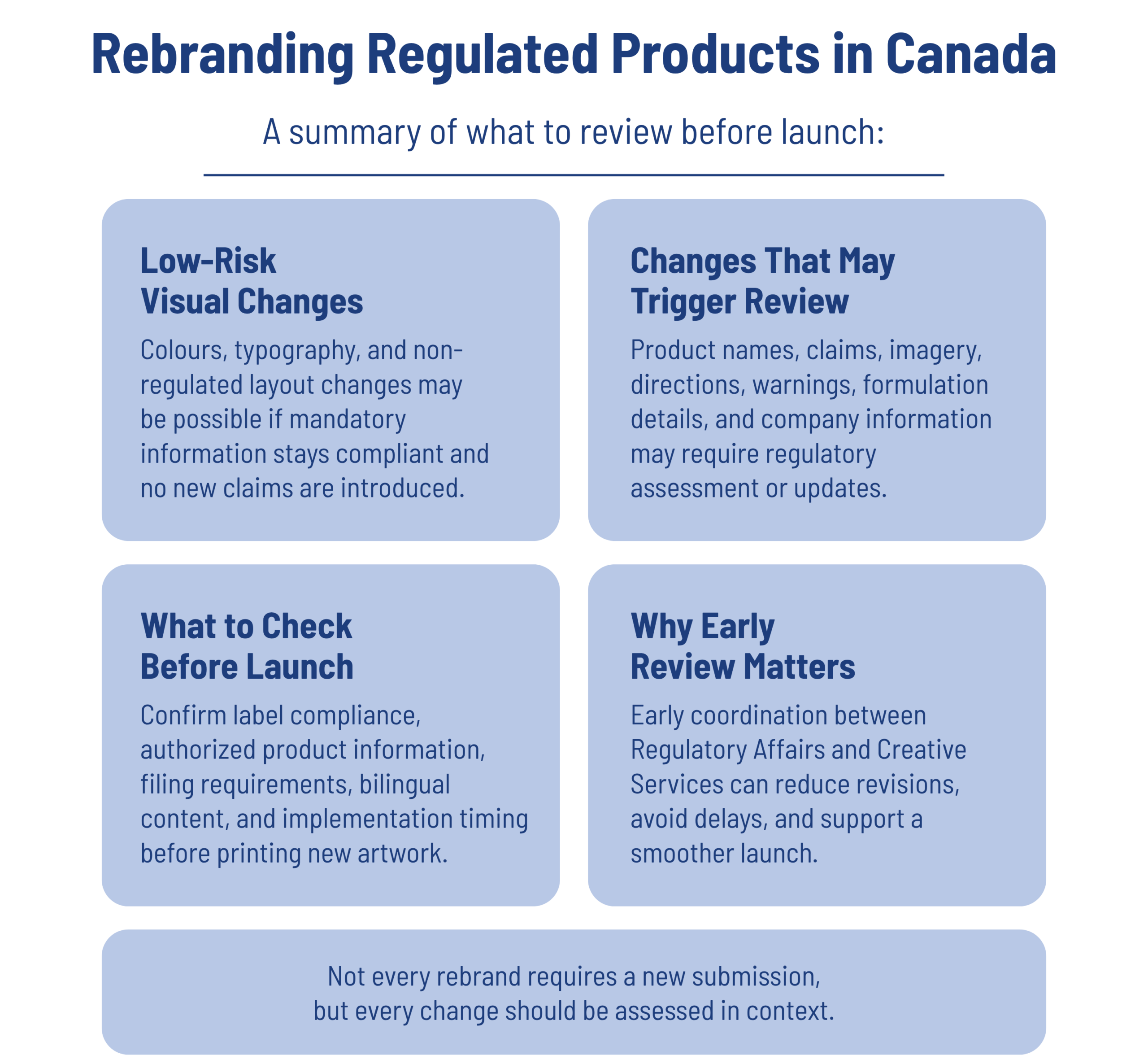
Changes to brand colours, logos, typography, or non-regulated layout elements may have limited regulatory implications, provided mandatory information remains compliant and the revised presentation does not introduce new express or implied claims.


Which Rebranding Changes Can Trigger Regulatory Requirements? 

Regulatory implications become more likely when a rebrand changes information that is governed by the applicable product framework. 


Common examples include: 

Product identity:

Changes to the product name, brand name, company information, or how the product is presented to consumers.

Claims and positioning:

New benefit statements, stronger marketing language, revised claims, or changes to how the product's purpose is represented.

Formulation:

Changes to medicinal, active, non-medicinal, or other ingredients, depending on the product category.

Directions and warnings:

Changes to recommended use, instructions, cautions, contraindications, or other regulated information.

Package configuration:

Changes to package size, format, or presentation where category-specific requirements apply.

Visual representations:

Imagery, symbols, graphics, or other design elements that may communicate an implied claim or affect how consumers understand the product.

Do Product and Brand Name Changes Require Regulatory Action?

One of the most important distinctions during a rebrand is the difference between a regulatory review and a regulatory filing.


A company may need to review the proposed artwork for compliance even when nothing needs to be submitted to Health Canada. Conversely, some changes require an administrative update or notification without requiring an entirely new market authorization.


Packaging Changes That May Not Require a Regulatory Filing

A visual refresh may require only an internal regulatory review when regulated product information remains unchanged and the new design continues to meet applicable labelling and advertising requirements.


The absence of a filing requirement does not mean that the artwork should bypass regulatory review. New imagery, altered prominence, changes to bilingual presentation, or modifications to the overall context of a claim can still create compliance concerns.


Packaging Changes That May Require a Health Canada Notification or Administrative Update

Some changes must be reported to the regulator but do not amount to a complete reassessment of the product.


For example, Health Canada’s current NHP post-licensing framework distinguishes between amendments, notifications, and other types of post-licence changes. Certain notifications must be submitted within 60 calendar days of the change.


Cosmetics operate under a different system. Health Canada requires an amended Cosmetic Notification Form (CNF) when information such as the primary product brand and name, contact information, or formulation changes. Revised information must generally be provided within 10 days after the information becomes inaccurate.


Product and brand-name changes may also require regulatory action where the revised name forms part of an existing licence, authorization, or notification. For example, Health Canada identifies brand-name changes within its NHP post-licensing framework, while certain pharmaceutical product-name changes may qualify for administrative processing. Revised names must also be assessed for implied claims or changes to the product’s authorized representations.


Packaging Changes That May Require a Regulatory Amendment or Approval

A proposed rebrand may require a more substantive regulatory pathway when it changes information central to the product’s authorization, safety, efficacy, quality, intended use, or regulatory classification.


The appropriate pathway depends on both the product category and the nature of the proposed change. This is why companies should avoid assuming that every packaging update is either “just design” or, at the other extreme, a completely new regulatory submission.

Rebranding Requirements by Product Category in Canada

A packaging or branding change does not have the same regulatory consequence across all regulated products in Canada. The requirements depend on the product category, the information being changed, and whether that information forms part of an existing licence, authorization, notification, or mandatory label requirement.

Natural Health Product (NHP) Rebranding and NPN Changes

Licensed Natural Health Products (NHPs) are subject to Health Canada's post-licensing requirements under the Natural Health Products Regulations. Depending on the nature of the proposed change, a rebrand may require a notification, amendment, or other regulatory action.

Changes to information such as the brand name, recommended conditions of use, ingredients, company information, or other details associated with the Product Licence should be assessed before revised packaging is finalized.

An NHP rebrand should therefore be reviewed against the existing Product Licence to confirm that claims, recommended use or purpose, risk information, directions, ingredients, and other licensed information remain consistent with the product's authorization.

Cosmetic Rebranding and Cosmetic Notification Changes

Cosmetics follow a notification-based framework rather than a pre-market product licensing system. Manufacturers and importers must notify Health Canada of cosmetics sold in Canada and keep the information provided through the Cosmetic Notification Form (CNF) current.

Changes to information such as the primary product brand and name, formulation, or company information may require the CNF to be updated. Health Canada generally requires revised information to be submitted within 10 days after previously provided information becomes inaccurate.

A cosmetic rebrand should therefore include a review of both the updated artwork and the existing CNF. Companies should also confirm that revised claims, product names, and visual representations remain consistent with the cosmetic classification, as therapeutic representations may raise a broader product classification issue.

Food Packaging Redesign and Labelling Compliance

Conventional foods do not generally follow the same post-licensing framework as NHPs or cosmetics. Instead, a packaging refresh should be assessed against the applicable requirements under the Food and Drugs Act and Food and Drug Regulations, as well as the Safe Food for Canadians Act and Safe Food for Canadians Regulations.

This includes requirements for elements such as the common name, ingredient and allergen declarations, nutrition information, net quantity, responsible party information, claims, mandatory symbols, and bilingual labelling.

A food packaging refresh is therefore an appropriate point to complete a full label compliance review and confirm that existing content remains current before it is carried into the new design.

Prescription and Non-Prescription Drug Packaging Changes

Prescription and non-prescription drugs are subject to separate post-authorization requirements. Certain manufacturer-name or product-name changes may be eligible for Health Canada's administrative processing pathway where the authorized product otherwise remains unchanged.

If a pharmaceutical rebrand also changes claims, indications, conditions of use, formulation, or other authorized information, the appropriate regulatory pathway should be confirmed before the revised packaging is implemented.

Which Product Rebranding Changes Can Trigger Regulatory Requirements?

Proposed Change 

Potential Regulatory Consideration 

Logo or colour palette 

Often limited regulatory impact if mandatory information and regulated representations remain compliant 

Typography or layout 

Review legibility, prominence, prescribed formatting, and placement requirements 

Product or brand name 

May require a notification, amendment, administrative update, or other post-market action depending on product category 

New benefit statement 

Requires review and may affect the existing authorization 

New product imagery 

May create an express or implied claim and should be assessed in context 

Formula or ingredient change 

In most cases, requires a regulatory assessment, notification, amendment, or authorization prior to implementation 

Directions or warnings 

In most cases, requires a regulatory assessment, notification, amendment, or authorization prior to implementation 

Company information 

May require updates to regulatory records and packaging 

Package size or configuration 

Requires category-specific assessment 

English/French presentation 

Must continue to meet applicable federal and provincial bilingual requirements 

The regulatory consequence depends on the product category and the complete context of the change. The table should therefore be used as a screening tool rather than as a substitute for a category-specific assessment. 

Claims and Marketing Changes During a Product Rebrand

Can New Packaging Claims Require Regulatory Review?

Claims deserve separate attention during a rebrand because even subtle wording changes can alter the scope or meaning of a product representation.

For licensed products, revised claims should remain within the existing authorization unless the appropriate regulatory change is completed.

For foods, claims must continue to meet applicable compositional, wording, substantiation, and presentation requirements. For this reason, new or revised claims should be assessed before they are incorporated into final packaging artwork.

Can Packaging Images and Graphics Create Implied Claims?

Visual elements can contribute to the overall representation of a product and should be assessed alongside the written copy.

Images, symbols, product photography, ingredient imagery, and other design elements may suggest a health benefit, physiological effect, intended use, or target population beyond the stated product claims.

The prominence, placement, and relationship between visual elements and claims can also influence the overall impression communicated to consumers. Regulatory review should therefore consider the complete artwork rather than assessing copy and design separately.

Quebec Packaging and French-Language Requirements During a Rebrand

A product rebrand intended for the Quebec market should account for provincial French-language requirements in addition to applicable federal labelling requirements. Under Quebec's Charter of the French Language, product and packaging information is generally required to appear in French, with additional requirements applying to the use and presentation of trademarks and descriptive wording. 

This becomes particularly relevant during a rebrand where new trademarks, descriptors, slogans, or other consumer-facing language are introduced. Reviewing Quebec requirements early in the design process can help avoid the need for a separate packaging revision after the broader Canadian artwork has been finalized. 

How to Rebrand a Regulated Product Without Unnecessary Regulatory Delays

Define Packaging and Labelling Changes Before Redesign Begins

Before initiating a rebrand, companies should establish which packaging elements will change and which must remain consistent with existing regulatory requirements. This includes identifying proposed updates to product names, claims, imagery, mandatory labelling, and other information associated with an existing authorization or notification.

Defining the scope early allows Regulatory Affairs to identify potential filing requirements and provides Creative Services with clear parameters before artwork development begins.

Establish Regulatory and Creative Design Guardrails

Regulatory and creative teams should work together to establish design parameters that maintain compliance while allowing flexibility in the refreshed visual identity. Regulatory Affairs can identify mandatory information, authorized representations, and category-specific labelling requirements, while Creative Services develops the new packaging within those boundaries.

This collaboration helps prevent design decisions from inadvertently introducing unsupported claims, compromising mandatory information, or requiring additional regulatory action.

Complete Regulatory Review Before Final Packaging Artwork

Once the revised artwork has been developed, a final regulatory review should confirm that the packaging meets applicable labelling requirements and remains consistent with the product's regulatory status.

Where regulatory filings or amendments are required, their implementation requirements should be confirmed before packaging is printed or released to market. Coordinating regulatory and creative activities throughout the process can help reduce late-stage revisions, unnecessary costs, and commercialization delays.

Timeline for Launching a Rebranded Product

Implementation timelines depend on the product category, the scope of the proposed changes, and whether regulatory action is required before the revised packaging can be introduced.


Can Rebranded Packaging Be Launched Immediately?

Some visual updates may be implemented without a formal regulatory submission, provided the revised packaging remains compliant. Other changes may require a notification, amendment, approval, or other regulatory action, with implementation timing determined by the applicable regulatory framework.

Companies should therefore confirm the relevant requirements before committing to packaging production, distribution, or a public rebrand launch.


Can Existing Product Inventory Be Sold After a Rebrand?

A visual rebrand does not necessarily require existing packaging to be discarded. Whether remaining inventory can continue to be sold depends on its compliance status, applicable regulatory requirements, existing authorizations or notifications, and any relevant transition provisions.

Inventory planning should therefore be incorporated into the rebranding strategy, with Regulatory Affairs confirming whether existing and revised packaging can coexist on the market and whether regulatory updates are required before introducing the new artwork.

Final Remarks

Rebranding a regulated product in Canada does not necessarily require a new regulatory submission or market authorization. However, even changes intended to be purely aesthetic can introduce compliance considerations when they affect product claims, mandatory labelling, or information associated with an existing authorization or notification.

The most effective approach is to incorporate regulatory considerations into the rebranding process from the outset, rather than addressing them after the artwork has been finalized. By aligning Regulatory Affairs and Creative Services early, companies can preserve their intended brand identity while minimizing unnecessary regulatory submissions, packaging revisions, and commercialization delays.

How SNI Can Support Your Product Rebrand

At Source Nutraceutical, Inc. (SNI), our Regulatory Affairs and Creative Services teams work together to help companies navigate the regulatory considerations of rebranding products for the Canadian market. From reviewing existing licences and packaging to assessing proposed claims, artwork, and branding changes, we help identify potential compliance issues before they affect production or launch timelines.

By combining regulatory expertise with in-house creative capabilities, SNI can support the rebranding process from initial concept through final artwork, helping companies minimize revisions while maintaining their commercial objectives.

Rebrand with Confidence

Planning a product rebrand? Contact SNI to discuss how our team can support your regulatory review, packaging redesign, and market readiness.

Book an introductory call using the following form:

Great! We’ve received your information. Our team will reach out shortly.

FAQ

Not necessarily. A label change does not automatically require regulatory action. It depends on what is changing and whether the changes affect regulated information, such as the product name, claims, ingredients, directions, company information, or other mandatory label requirements.

Potentially. Even if the formulation stays the same, a new product name may affect the product’s existing regulatory information or classification. The proposed name should be reviewed before new packaging is finalized.

Simple visual changes may not require regulatory action, but the updated label must still meet applicable Canadian requirements. Changes to imagery, wording, or positioning can also affect how a product is represented and should be assessed where they may introduce new claims or implications.

Yes. Changes to marketing language, benefit statements, or other claims can affect how a product is classified or represented in Canada. Claims should be reviewed before they appear on final packaging.

A company or brand identity change may affect information associated with the product’s regulatory record. Depending on the product category and the nature of the change, an update, notification, amendment, or other regulatory action may be required. 

It is generally better to involve Regulatory Affairs early. Identifying new or altered requirements before artwork is finalized can help prevent redesigns, delays, and unexpected production costs.

Not always. Whether a new licence, notification, amendment, or other regulatory action is required depends on the product category and the specific changes being made.

Providing the current artwork, proposed new artwork or design direction, existing product information, regulatory documentation, and a summary of the planned changes can help the regulatory team assess the potential impact.

Yes. SNI’s Regulatory Affairs and Creative Services teams can work together to assess proposed changes and develop updated packaging that aligns with Canadian regulatory requirements and your brand objectives.

As early as possible. Early review helps establish what can change, what needs to remain consistent, and whether any regulatory steps should be completed before final artwork or production.

Share the Post:

Related Posts

Image showing a prototype cracker package with SNI creative services logo and branding on a retail shelf with blue overlay

Compliant Product Labels for Canadian Markets

Not sure where to start with compliant product label design in Canada? Learn how regulatory requirements, bilingual content, packaging specifications, and creative design work together before artwork goes to print.

The content on this website, including information presented in this post, is provided for general informational purposes only and does not constitute legal, regulatory, or professional advice. While efforts are made to ensure accuracy, laws and regulations vary by jurisdiction and may change over time. Readers should not rely on this information as a substitute for advice from qualified legal or regulatory professionals. We disclaim any liability for actions taken based on this content, and users are encouraged to seek guidance specific to their circumstances.

Join Our Newsletter

Loading...