
How Long Does It Take to Get a Natural Product Number (NPN) in Canada?
Obtaining a Natural Product Number (NPN) in Canada typically takes approximately 60 calendar days for Class I applications, 90


Canada's natural health product (NHP) industry is facing a period of regulatory and commercial change. From proposed amendments to the Natural Health Products Regulations to evolving trade relations and emerging marketing trends, businesses must navigate developments that could influence compliance costs, market access, and long-term competitiveness.
On September 25, 2026, during the Canadian Health Food Association (CHFA) NOW conference session held in Toronto, representatives from their Regulatory Affairs and Government Relations teams, alongside trade policy experts, discussed the issues shaping the Canadian health and wellness sector.
In this article, we explore key industry insights and what they could mean for manufacturers, importers, distributors, and brand owners.
The growing popularity of GLP-1 medications has created new marketing opportunities across the health and wellness sector. However, CHFA cautioned that connecting NHPs or foods to prescription drug therapies may introduce significant regulatory risks.
During the session, CHFA confirmed that Health Canada had contacted the association regarding the increasing use of GLP-1 terminology in product branding and marketing.
Expressions such as "GLP-1 friendly" may imply that a product is intended to address the effects or adverse reactions associated with prescription drug treatment. Depending on the wording and overall presentation, these representations could raise concerns regarding unauthorized therapeutic claims, product classification and compliance with Canadian advertising requirements.
CHFA indicated that regulatory intervention could include stop-sale measures, depending on the circumstances. Although recalls were discussed, no specific enforcement action or general recall requirement was confirmed.
Rather than referencing GLP-1 medications, CHFA encouraged businesses to emphasize established nutritional characteristics, such as protein or fibre content, where supported, and permitted under the applicable regulatory framework.
What this means for industry: Companies considering GLP-1-related branding should assess proposed product names, packaging, websites and promotional materials before implementation. A marketing trend does not establish an acceptable regulatory claim.
One of the central discussions during the Regulatory Forum session focused on Health Canada's proposed regulatory amendments intended to reduce administrative requirements for NHPs (commonly referred to as “red-tape reduction”).
The proposed registration pathway for certain NHPs is intended to simplify aspects of the existing licensing process. However, CHFA questioned whether the anticipated savings adequately reflect the cumulative costs of other regulatory changes affecting the sector.
During the presentation, CHFA shared the following industry-wide estimates:
Regulatory initiative:
Proposed NHP registration reforms
Estimated financial impact:
$13–14 million in annual savings
Regulatory initiative:
GMP-related changes
Estimated financial impact:
$90–122 million in additional annual costs
Regulatory initiative:
Potential sector-wide labelling changes
Estimated financial impact:
$200–400 million in implementation costs
These figures reflect estimates presented by CHFA and should not be interpreted as confirmed Health Canada assessments or finalized industry expenditures.
CHFA expressed concern that businesses responding to regulatory consultations may underestimate the actual costs associated with proposed requirements.
Beyond government fees, regulatory implementation can involve consulting expenses, quality management system updates, personnel training, revised procedures, packaging redesigns, and inventory management. These indirect costs are particularly relevant for smaller businesses with limited internal regulatory (and financial) resources.
CHFA emphasized that incomplete cost submissions could influence how government evaluates the financial implications of proposed reforms. The association encouraged businesses to provide comprehensive, evidence-based information reflecting their actual operational requirements.
What this means for industry: Regulatory changes should be assessed collectively. Savings associated with streamlined licensing may be offset by additional obligations involving GMP, labelling, or quality systems.
CHFA also addressed Bill C-224, a federal legislative proposal seeking to reconsider the application of certain provisions of the Food and Drugs Act related to NHPs.
The discussion focused on authorities associated with the Protecting Canadians from Unsafe Drugs Act, commonly known as Vanessa's Law, which were extended to NHPs through legislative amendments in 2023.
CHFA argued that applying enhanced regulatory authorities originally established for higher-risk therapeutic products (i.e. prescription drugs) may impose disproportionate requirements on the NHP sector.
The association's position is that regulatory oversight should remain proportionate to the overall risks associated with the product category.
The legislative discussion focuses on the extent to which NHPs should remain subject to enhanced post-market authorities, including certain recall powers, information requirements, and financial penalties.
CHFA encouraged businesses to participate in parliamentary proceedings and communicate their perspectives to elected representatives.
Importantly, Bill C-224 remains a legislative proposal unless enacted. Existing regulatory requirements and enforcement authorities continue to apply.
For businesses, the broader issue extends beyond individual compliance obligations. The legislative outcome could influence the long-term structure of Canada's NHP regulatory framework and the approach taken to future reforms.
Personal importation of NHPs was another concern raised by CHFA, particularly the competitive relationship between domestically regulated products and NHPs purchased directly from foreign sellers.
During the session, CHFA referenced an estimated $450 million in NHPs entering Canada through personal importation. The association argued that Canadian businesses must invest in product licensing, quality assurance, bilingual labelling, and other compliance activities, while certain products obtained through international direct-to-consumer channels may not face equivalent commercial market-entry processes.
CHFA indicated that it had raised these concerns with federal representatives and was advocating for further examination of Canada’s personal importation framework for NHPs. However, personal importation, customs treatment, and commercial product authorization are distinct regulatory considerations. The discussion should not be interpreted as confirmation that personally imported products are universally exempt from Canadian requirements.
For Canadian NHP manufacturers, importers and brand owners, personal importation highlights the relationship between regulatory compliance costs, pricing competitiveness, and cross-border e-commerce. Businesses may need to monitor how foreign direct-to-consumer sales affect market positioning, consumer expectations and long-term competitiveness in Canada’s natural health product industry.
International trade was another major focus of the conference. Trade policy expert Dr. Anne Tanner discussed the ongoing uncertainty surrounding Canada–U.S. trade relations and the commercial consequences of changing tariff measures. For businesses operating across both markets, tariffs can influence ingredient sourcing, contract manufacturing, finished product pricing, inventory management, and distribution arrangements.
The Canada–United States–Mexico Agreement (CUSMA) continues to provide preferential tariff treatment for qualifying goods. However, companies must distinguish between products shipped from Canada and products that satisfy CUSMA's applicable rules of origin.
A Canadian shipping address or manufacturing location does not automatically establish originating status. Furthermore, qualifying products may still be subject to separate trade measures depending on their tariff classification and applicable requirements.
Businesses should therefore verify their Harmonized System classification, country-of-origin determination, eligibility for preferential treatment, and exposure to additional tariffs.
The conference also highlighted the availability of Canadian tariff relief mechanisms for certain businesses affected by retaliatory measures. Depending on the applicable program and circumstances, companies may be eligible to request remission or other forms of relief.
Eligibility is not automatic and must be assessed against the relevant government requirements. CHFA encouraged businesses to investigate available relief options rather than automatically absorbing additional tariff costs.
Although expanding into international markets may reduce reliance on established North American supply chains, diversification introduces its own challenges. Entering the European Union, China, or other jurisdictions can involve different requirements for product classification, ingredients, claims, labelling, and market authorization.
The conference emphasized that replacing established suppliers or entering new markets is rarely as straightforward as commercial discussions may suggest. For businesses considering international expansion, regulatory due diligence should form part of the initial market feasibility assessment.
Despite ongoing trade challenges, CHFA highlighted opportunities for Canadian health and wellness businesses seeking international growth. Through initiatives supported by the federal AgriMarketing Program, CHFA has been facilitating export development activities, including trade missions, international exhibitions, and buyer engagement.
During the session, CHFA reported receiving approximately $160,000 in its first year of funding and $325,000 in the subsequent year. The association also indicated that it had requested additional funding exceeding $1 million for 2027 and beyond.
Activities discussed included trade missions to China, pre-arranged buyer meetings, and assistance for businesses unfamiliar with foreign markets.
CHFA also reported buyer interest from markets including the United Kingdom, Ireland, the Philippines, and Saudi Arabia.
These initiatives may provide opportunities for Canadian companies seeking to diversify distribution channels. However, export development support does not replace the need to establish regulatory compliance in each destination market.
CHFA also discussed parliamentary activity concerning perimenopause and menopause, particularly work undertaken by the House of Commons Standing Committee on the Status of Women (FEWO). The committee’s study examines the effects of perimenopause and menopause on women’s participation in the workforce.
CHFA identified an opportunity for the NHP industry to contribute to broader discussions about women’s health, consumer education, and access to health-related products. The association reported submitting comments to the committee and engaging with parliamentarians involved in related policy discussions. For the NHP industry, this represents an opportunity to communicate the role of appropriately authorized products in supporting specific health and wellness needs.
Nevertheless, companies must distinguish between broader health policy discussions and the therapeutic claims permitted for individual products. Marketing representations concerning menopause-related symptoms remain subject to applicable authorization and evidence requirements.
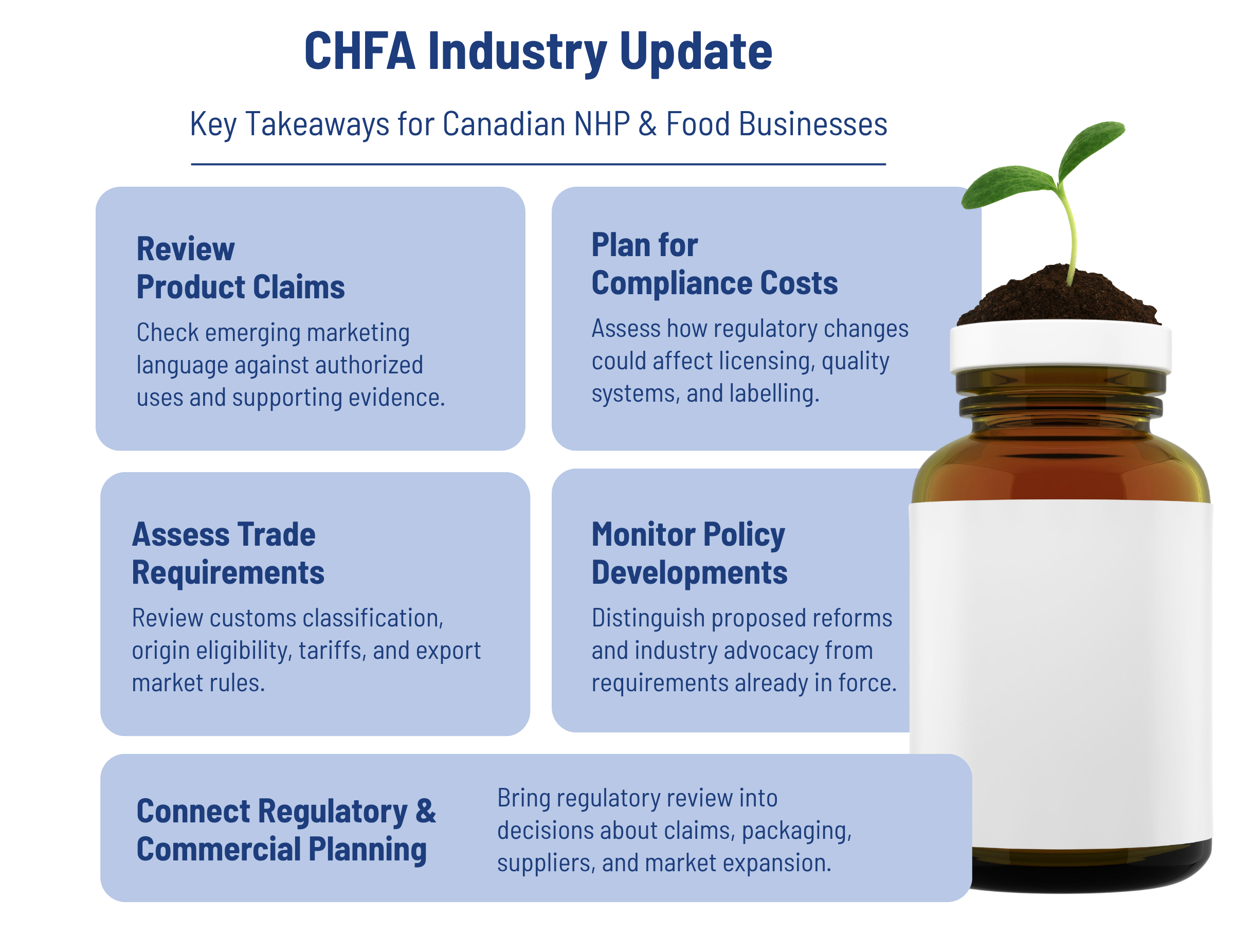
The conference highlighted the importance of proactive regulatory planning across several areas. Companies should review emerging marketing claims before incorporating pharmaceutical terminology into product positioning, particularly where the proposed language could imply unauthorized therapeutic uses.
Businesses should also assess the cumulative financial implications of regulatory reform, including proposed licensing changes, GMP requirements, and labelling obligations.
For companies engaged in international trade, customs classification, CUSMA origin eligibility, applicable tariffs, and destination-market regulatory requirements should remain central considerations.
Finally, legislative and policy developments warrant ongoing attention. Industry consultations and parliamentary proceedings can influence future regulatory obligations, making early awareness important for long-term planning.
A recurring theme throughout CHFA's conference discussion was the relationship between regulatory policy and business competitiveness. Although proposed reforms may simplify certain administrative processes, businesses must also consider the broader costs of maintaining compliance, adapting to changing requirements, and entering new markets.
For Canadian NHP and food companies, regulatory planning extends beyond obtaining an initial licence or completing a label review. It also involves understanding how evolving legislation, market trends, and international trade policies may affect products throughout their commercial lifecycle.
A recurring theme throughout CHFA's conference discussion was the relationship between regulatory policy and business competitiveness. Although proposed reforms may simplify certain administrative processes, businesses must also consider the broader costs of maintaining compliance, adapting to changing requirements, and entering new markets.
For Canadian NHP and food companies, regulatory planning extends beyond obtaining an initial licence or completing a label review. It also involves understanding how evolving legislation, market trends, and international trade policies may affect products throughout their commercial lifecycle.
The CHFA NOW discussions highlighted how closely regulatory developments are tied to the competitiveness of Canada’s natural health product and food businesses. Changes affecting claims, licensing, quality systems, and labelling can influence product positioning, operating costs, and expansion plans. Proposed reforms and industry advocacy therefore warrant attention, while remaining distinct from requirements already in force.
For manufacturers, importers, and brand owners, the practical priority is to bring regulatory considerations into commercial decisions early. Assessing the implications before committing to new claims, packaging, suppliers, or export markets can help businesses limit avoidable rework, plan investment, and pursue growth on a stronger compliance foundation.
Emerging marketing trends can create new opportunities, but they also introduce regulatory considerations. With over 20 years of consulting experience and more than 100 years of collective regulatory expertise, Source Nutraceutical, Inc. (SNI) helps businesses assess product claims, labelling, and promotional materials before they reach the Canadian market.

Obtaining a Natural Product Number (NPN) in Canada typically takes approximately 60 calendar days for Class I applications, 90
Health Canada’s Draft NHP Quality Guide marks a significant shift towards lifecycle quality oversight for Natural Health Products (NHPs). It emphasizes that obtaining a Natural Product Number (NPN) is just the start of a brand’s quality journey. Companies must understand the implications for documentation, quality agreements, and ongoing management. Learn more.