
visit sniclinic dot com here

How a Canadian Natural Product Number (NPN) Can Support International Market Entry

How a Canadian Natural Product Number (NPN) Can Support International Market Entry

For natural health product (NHP) manufacturers and brand owners, obtaining a Natural Product Number (NPN) is a required step before selling products in Canada. However, the benefits of Canadian NHP licensing may extend beyond the domestic market.

An existing NPN can provide a valuable starting point for businesses considering international expansion. By establishing a documented regulatory history, Canadian product authorization can support discussions with foreign distributors, inform international regulatory assessments, and help licence holders evaluate opportunities in new markets.

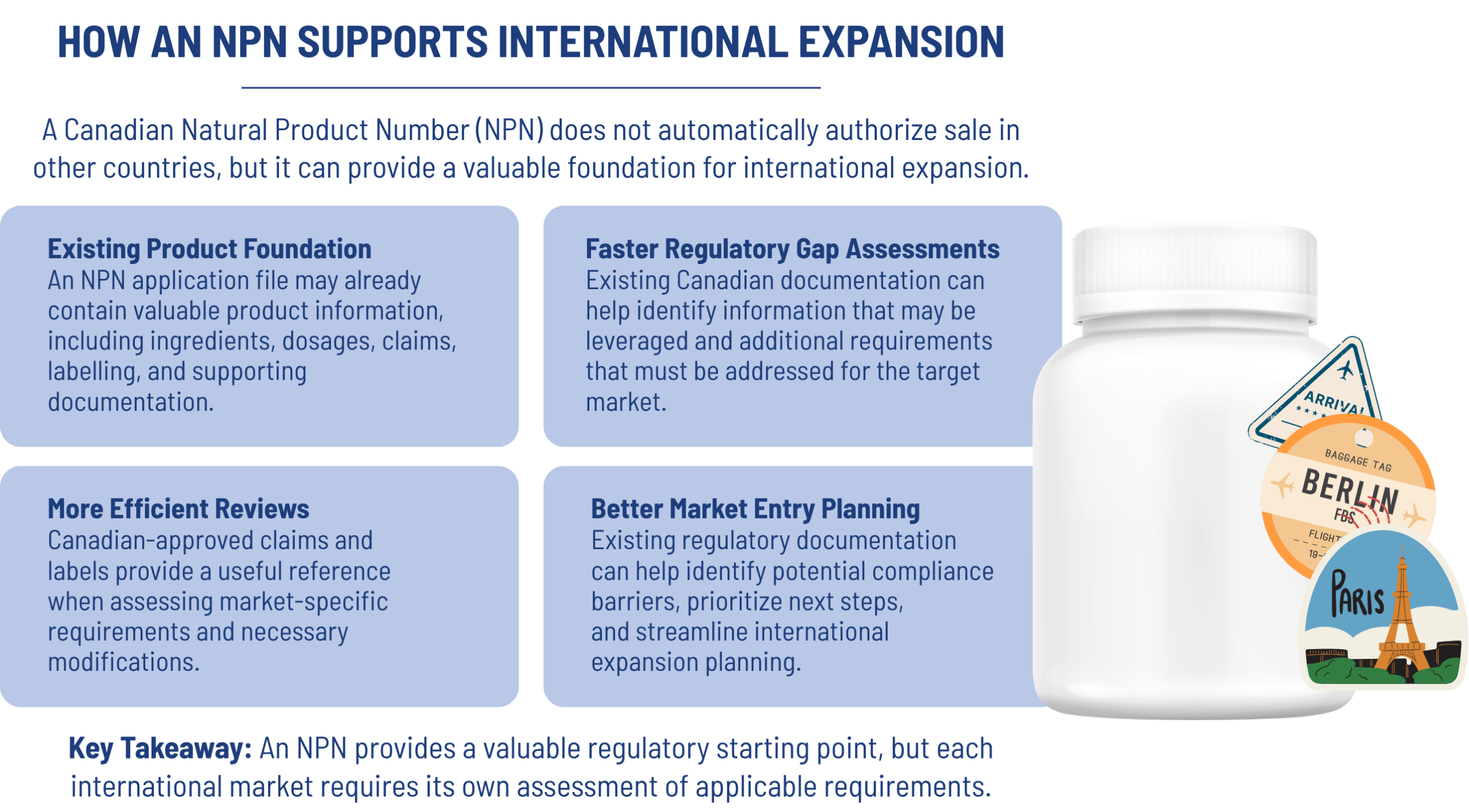
Although an NPN does not automatically authorize a product for sale outside Canada, understanding its potential international value can help businesses approach global market entry more strategically.

Show Table of Contents

The Benefits of Obtaining a Canadian Natural Product Number (NPN)

Under Canada's Natural Health Products Regulations, NHPs require a product licence before they can be sold domestically. An eight-digit NPN confirms that Health Canada has assessed a product for safety, efficacy, and quality under its recommended conditions of use.

Licensed products are publicly available in Health Canada's Licensed Natural Health Products Database (LNHPD), allowing interested parties to verify their Canadian regulatory status, ingredients, recommended uses, and other terms of authorization .

For product licence holders, this means that obtaining an NPN establishes more than permission to enter the Canadian market. It also creates a verifiable regulatory reference that may prove useful when exploring international opportunities.

Canadian Food Claim Regulations: Health Canada and CFIA Requirements

An existing NPN may offer several advantages to businesses considering expansion beyond Canada: 

Regulatory Credibility

Demonstrates that the product has undergone a formal Canadian regulatory assessment.

Distributor Confidence

Provides potential international partners with a publicly verifiable record of Canadian authorization.

Existing Product Documentation

Establishes a foundation of formulation, safety, and quality information that may support further regulatory evaluations.

Market Expansion Planning

Helps businesses identify differences between Canadian and foreign requirements before entering new jurisdictions.

These advantages are particularly relevant when approaching prospective importers and distributors who may be unfamiliar with the product or its regulatory history.

How Canadian Natural Health Product (NHP) Licensing Can Support Global Market Expansion

Building Confidence with International Distributors and Importers

When evaluating new products, international distributors must consider both commercial potential and regulatory feasibility. An existing NPN can support these evaluations by demonstrating that the product has already undergone regulatory assessment in Canada. Rather than relying exclusively on product licence holder representations, prospective partners can independently confirm its Canadian licensing status.

This level of transparency may help establish credibility during early commercial discussions, particularly when accompanied by relevant product specifications and manufacturing information. However, an NPN should be presented as evidence of Canadian authorization, rather than a confirmation of the product's compliance with foreign requirements.

Using Existing NHP Documentation to Support International Regulatory Assessments

One of the less obvious benefits of obtaining an NPN is the regulatory documentation developed throughout the Canadian licensing process. Depending on the product and application pathway, this information may include ingredient specifications, safety evidence, recommended conditions of use, and supporting quality documentation.

When a product licence holder decides to explore a market outside of Canada,, relevant portions of this information may be used to support preliminary compliance assessments or prepare documentation for foreign regulatory processes.

Although additional evidence may be necessary, having an established product dossier can help businesses identify regulatory gaps earlier and determine which markets are commercially and technically feasible.

How Is a Canadian Natural Product Number (NPN) Recognized in International Markets?

The regulatory significance of a Canadian NPN varies across jurisdictions. While foreign regulators generally do not recognize an NPN as equivalent to their own market authorization, the supporting documentation may still provide commercial or regulatory value.

United States: Supporting Dietary Supplement Market Entry

In the United States, dietary supplements are regulated by the Food and Drug Administration (FDA). Unlike Canada's NHP framework, most dietary supplements do not require FDA approval before marketing.

How the NPN can help:

An existing NPN provides evidence of Canadian regulatory assessment that may support distributor evaluations and reviews of the product's formulation and supporting safety information.

Additional considerations:

Businesses must independently assess ingredient eligibility, applicable New Dietary Ingredient requirements, manufacturing standards, U.S. labelling, and permitted claims. Canadian-approved therapeutic claims may not be acceptable for U.S. dietary supplements.

European Union (EU): Supporting Food Supplement Compliance

In the European Union (EU), products comparable to Canadian NHPs are commonly regulated as food supplements. While certain requirements are harmonized across the EU, individual Member States may impose additional national obligations. 

How the NPN can help:

Canadian licensing documentation may provide useful information for ingredient assessments, safety evaluations, and discussions with prospective European distributors.

Additional considerations:

Manufacturers should evaluate ingredient restrictions, novel food status, permitted health claims, local labelling, and notification requirements in their intended Member States.

United Kingdom: Supporting Food Supplement Market Entry

The United Kingdom regulates food supplements under applicable domestic food legislation, with certain regulatory differences between Great Britain and Northern Ireland.

How the NPN can help:

An existing NPN may support initial distributor evaluations by providing a verifiable Canadian authorization and established product information.

Additional considerations:

Businesses must assess applicable ingredient requirements, product classification, health claims, and labelling obligations. Requirements may differ depending on whether products are intended for Great Britain or Northern Ireland.

Australia: Supporting Complementary Medicine Market Entry

In Australia, many products comparable to Canadian NHPs are regulated as complementary medicines under the Therapeutic Goods Administration (TGA).

How the NPN can help:

Canadian regulatory documentation may provide a useful foundation for assessing the product against Australian requirements and preparing supporting evidence.

Additional considerations:

Relevant products generally require inclusion in the Australian Register of Therapeutic Goods (ARTG) before supply, unless an exemption applies. Manufacturers must also consider permitted ingredients, indications, evidence requirements, Australian sponsorship, and applicable manufacturing standards.

Other International Markets: Expanding Beyond Established Supplement Markets

Canadian NHP manufacturers may also identify opportunities in Asia, Latin America, the Middle East, and other international markets.

How the NPN can help:

An NPN may demonstrate an existing regulatory history and support preliminary commercial discussions with prospective importers and distributors.

Additional considerations:

Depending on the jurisdiction, market entry may involve local product registration, ingredient restrictions, import permits, translated documentation, or additional safety and quality evidence.

The extent to which Canadian authorization or supporting documentation is considered by foreign authorities must be assessed individually for each destination.

How to Leverage an Existing Natural Product Number (NPN) for International Expansion

Identifying International Markets for Canadian NHPs

An existing NPN can provide a practical starting point for evaluating international expansion opportunities. Rather than selecting markets based solely on consumer demand, businesses can compare their Canadian-authorized formulation against the requirements of prospective destinations. 

This preliminary assessment may help determine whether the product can be marketed with relatively minor modifications or whether significant changes to its ingredients, claims, or labelling are required. 

By considering regulatory feasibility alongside commercial opportunities, manufacturers can prioritize markets that align with their existing product portfolio. 

Understanding the Limitations of NPN Recognition Outside Canada

Although Canadian NHP licensing offers potential international advantages, it is important to recognize that an NPN does not replace foreign regulatory requirements. A product authorized in Canada may be subject to different classifications, ingredient restrictions, or permitted claims in another jurisdiction.

Furthermore, the regulatory assessment conducted by Health Canada does not guarantee that foreign authorities will accept the same scientific evidence or quality documentation. 

Consequently, businesses should treat an existing NPN as a regulatory starting point rather than automatic international approval. 

Final Remarks: Turning Canadian NHP Licensing into International Opportunities

Obtaining an NPN accomplishes more than securing Canadian market access—it establishes a structured regulatory foundation that can support distributor reviews, technical evaluations, and long-term export strategies. 

Because Health Canada’s licensing process requires fully defined ingredient specifications, safety evidence, and approved conditions of use, the resulting dossier serves as a reliable reference point when entering foreign jurisdictions. While an NPN does not replace destination-specific registrations, aligning your initial Canadian licensing strategy with international standards allows you to evaluate global market potential early—without duplicating regulatory effort down the line. 

How SNI Supports International Market Entry

Expanding into international markets presents new commercial opportunities for Canadian NHP brands, but an existing Canadian product licence does not automatically establish compliance in other jurisdictions. Differences in product classification, permitted ingredients, dosage limits, health claims, labelling, and market authorization requirements can significantly influence a product's eligibility for sale.

Source Nutraceutical Inc. (SNI) supports manufacturers, brand owners, product licence holders, and distributors in assessing international regulatory requirements and developing practical market-entry strategies. With regulatory expertise spanning Canada, the United States, and the European Union, our team helps businesses identify compliance gaps, understand jurisdiction-specific obligations, and determine the regulatory activities needed to support international commercialization.

Expanding Your Natural Health Product (NHP) Beyond Canada?

Whether entering a new international market or expanding an existing product portfolio, SNI supports brands through regulatory gap assessments, product classification and ingredient compliance reviews, claims and labelling assessments, and applicable regulatory submissions. Our team also helps identify potential compliance barriers and develop practical market-entry strategies tailored to the target jurisdiction.

Existing Canadian NHP documentation can provide a valuable foundation for international expansion. SNI helps determine what can be leveraged, what requires modification, and which additional regulatory steps are necessary to support successful market entry.

Ready to start? Connect with SNI's Regulatory Affairs team to evaluate your existing product documentation, identify potential compliance gaps, and establish a practical path toward international market entry.

Book an introductory call using the following form:

Great! We’ve received your information. Our team will reach out shortly.

FAQ

Yes. Through authorized third-party issuing bodies (such as the Canadian Health Food Association (CHFA) or Food, Health & Consumer Products of Canada (FHCP), businesses can apply for an "ITC: Export Only". This certificate validates that the manufacturing, packaging, or labelling site operates under a valid Canadian Site Licence compliant with Canadian Good Manufacturing Practices (GMP), even if the NHP is not actively distributed in the domestic market.

An NPN alone is not enough. Export certificates like an ITC evaluate both product authorization and site compliance. To receive a standard ITC, the product must hold an active NPN and be manufactured, packaged, and labeled at facilities that hold a valid Health Canada Site Licence (SL). Confirming your contract manufacturer's site license status is a pre-requisite for issuing export documentation.

Not necessarily. While an NPN holder owns the product licence, the underlying technical master files, such as detailed manufacturing processes, raw material supplier details, and proprietary testing protocols, are frequently owned by the contract manufacturer. Before targeting markets that require full technical master file submissions, you must establish access rights, data-sharing agreements, or confidential regulatory master file submission arrangements with your suppliers. 

No. An NPN confirms that Health Canada has authorized the product for sale in Canada, but it does not serve as proof of commercial marketplace presence. If a foreign regulatory agency or importer requires evidence of actual commercial distribution, such as proof of active market sales, you may need to provide supplementary commercial records, such as active Canadian retail invoices, bills of lading, or a Certificate of Free Sale (CFS). 

Yes, but through a different regulatory pathway. If a destination market classifies your NHP as a food commodity (or if export relies on food-based trade routes), an NPN entry serves as a baseline for ingredient safety and formulation composition. However, physical exports in these cases must be routed through the CFIA, requiring the exporter to hold a Safe Food for Canadians (SFC) licence and maintain a written Preventive Control Plan (PCP). 

Share the Post:

Related Posts

The content on this website, including information presented in this post, is provided for general informational purposes only and does not constitute legal, regulatory, or professional advice. While efforts are made to ensure accuracy, laws and regulations vary by jurisdiction and may change over time. Readers should not rely on this information as a substitute for advice from qualified legal or regulatory professionals. We disclaim any liability for actions taken based on this content, and users are encouraged to seek guidance specific to their circumstances.

Join Our Newsletter

Loading...