

visit sniclinic dot com here

Industry Insights: Retail Merchandising in Canada: CHFA NOW Recap

Retail Merchandising in Canada: CHFA NOW Recap

Getting a product onto a retailer’s shelf is a significant milestone. Getting shoppers to notice it, understand its value, and purchase it requires a different kind of preparation. For emerging food and natural health product (NHP) brands, retail merchandising connects market entry with the commercial performance needed to maintain and expand distribution.

At CHFA NOW in Toronto on September 25, 2026, a retail merchandising panel explored how brands and retailers can work together to improve product discovery, shopper engagement, and sales growth. The discussion highlighted a consistent message: a listing alone is not a sales strategy. Product visibility, retailer collaboration, consumer education, and realistic inventory planning all influence whether a brand earns its place in the shopping basket.

Show Table of Contents

Retail Merchandising in Canada

Improving Product Visibility Through In-Store Merchandising

Secondary Displays, Cross-Merchandising, and Product Demonstrations

The panellists emphasised that promising products can struggle when their placement provides limited opportunity for discovery. A small presence within a crowded category may secure distribution without generating meaningful shopper attention. Secondary displays, cross-merchandising, and in-store demonstrations can help introduce products in contexts where their purpose becomes easier to understand.

Aligning Product Placement with Retailer Standards

Pairing olive oil with tomatoes or peanut butter with apples, for example, connects a product with an immediate use occasion. However, successful grocery merchandising must reflect each retailer’s store layout, available space, and merchandising standards. Brands should investigate which display formats a retailer supports before proposing an activation, rather than assuming the same approach will work across every banner.

Preparing a Retail Buyer Pitch: Category Fit and Launch Support

Demonstrating Category Fit, Pricing, and Product Value

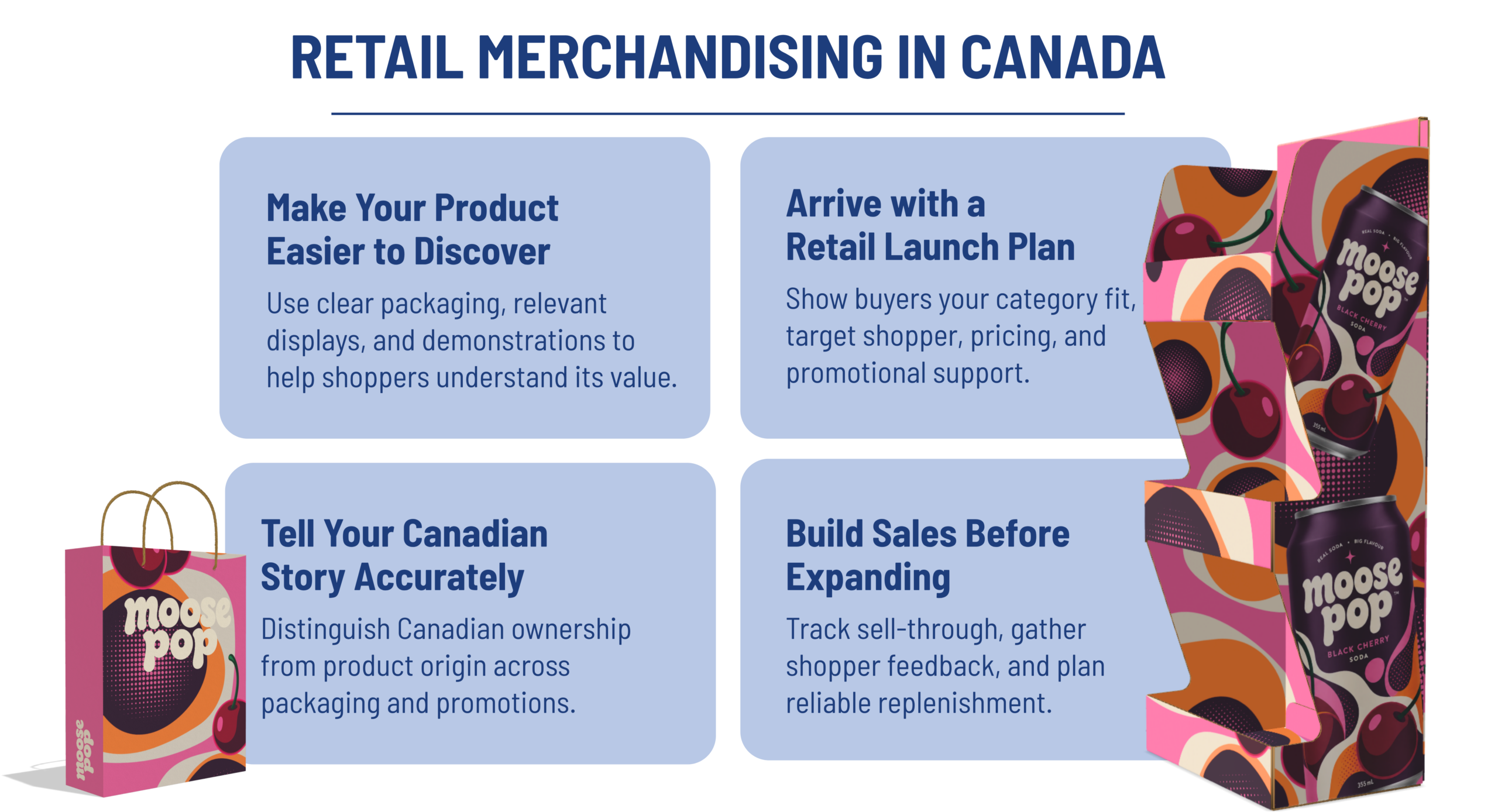
One of the clearest lessons from the discussion was that brands need to explain how their products contribute to the retailer’s category. A compelling founder story can support the pitch, but buyers also need a credible rationale for the proposed price, packaging format, target shopper, and promotional investment.

Building a Retail Launch and Promotional Plan

Preparation should begin with visiting stores, reviewing competing products, and understanding where the brand would fit. A practical retail launch plan should connect consumer marketing with in-store execution, including demonstrations, promotional timing, and replenishment. Presenting this information clearly helps buyers assess the opportunity and reduces the work required to bring it to market. The distinction matters, as enthusiasm for a product becomes more persuasive when accompanied by evidence that the brand understands the retailer’s business. 

Promoting Canadian Food Brands: Storytelling and Origin Claims

Connecting with Shoppers Through Canadian Brand Stories

The panel also highlighted opportunities to communicate Canadian and local brand stories through packaging, displays, flyers, and digital channels. Founder-led businesses, family ownership, and regional connections can give shoppers a reason to investigate an unfamiliar product, particularly when that story is communicated before the store visit. 

Using Canadian Origin Claims on Food Labels and Displays

For food brands, this messaging also requires regulatory care. Canadian ownership and Canadian product origin are different attributes, and “Product of Canada” and “Made in Canada” claims have distinct conditions. The Canadian Food Inspection Agency (CFIA) also recommends placing an appropriate domestic content statement near a maple leaf used on packaging, retail shelves, or online to clarify its meaning. Brand storytelling should therefore communicate the specific Canadian connection accurately and consistently across consumer touchpoints. 

Building Retail Sales Before Expanding Distribution

Matching Retail Distribution to Sales and Supply Capacity

Another recurring theme was the importance of matching retail expansion to operational readiness. A large opening order may appear successful, but excess inventory can undermine the retailer relationship if the product does not sell through. Sustainable growth depends on consumer purchases, reliable replenishment, and the capacity to support repeat promotions. 

Testing Regional Demand and Measuring Sales Velocity

For emerging brands, a smaller regional launch can provide an opportunity to assess sales velocity, gather shopper feedback, and refine merchandising before expanding. The panellists also described the value of combining sales data with direct observation, including checking whether packaging fits the shelf, whether shoppers can find the product, and whether demonstrations improve engagement. These practical details help explain performance that sales figures alone may not capture. 

Preparing Your Brand for Canadian Retail Success

Effective retail merchandising begins before the buyer meeting and continues after the first shipment. Brands that understand the category, support product discovery, and plan for realistic sales volumes are better prepared to build lasting retailer relationships. For businesses preparing to enter Canadian retail, packaging, claims, and promotional materials should be considered together.  

Preparing Your Product for Canadian Retail?

Source Nutraceutical, Inc. (SNI) brings regulatory expertise and creative support together to help brands prepare for market. From label and claims reviews to packaging design, our team helps you communicate your product’s value while addressing applicable Canadian requirements.

Contact us to discuss your product’s next steps!

Book an introductory call using the following form:

Great! We’ve received your information. Our team will reach out shortly.

FAQ

What Is Retail Merchandising, and Why Is It Important?

Retail merchandising involves planning how products are selected, priced, displayed, and promoted to encourage purchases. It helps shoppers find products, understand their value, and make purchasing decisions. For food and natural health product brands, effective merchandising supports the transition from securing shelf space to generating consumer sales. 

How Do You Get a Food Product into Canadian Grocery Stores?

Start by identifying retailers whose customers, price points, and product categories align with your offering. Prepare a buyer presentation explaining the product’s differentiation, target market, pricing, supply capacity, and promotional support. Brands should also determine whether to supply stores directly or work through a distributor, and confirm each retailer’s supplier requirements before approaching buyers. 

What Is Cross-Merchandising in Grocery Stores?

Cross-merchandising means displaying complementary products from different categories together, such as pasta beside sauce or peanut butter near apples. It helps shoppers identify useful combinations and discover products outside their usual aisles. For emerging food brands, a relevant secondary placement can provide additional exposure while making the shopping experience more convenient. 

How Do You Measure the Success of Retail Merchandising?

Measure performance through sales, sell-through rates, inventory turnover, and profitability. For brands, tracking units sold per store over a consistent period can also help assess whether a display or promotion improves sales velocity. Compare similar periods and account for price changes, stock availability, and seasonality before attributing an improvement to merchandising alone. 

Share the Post:

Related Posts

The content on this website, including information presented in this post, is provided for general informational purposes only and does not constitute legal, regulatory, or professional advice. While efforts are made to ensure accuracy, laws and regulations vary by jurisdiction and may change over time. Readers should not rely on this information as a substitute for advice from qualified legal or regulatory professionals. We disclaim any liability for actions taken based on this content, and users are encouraged to seek guidance specific to their circumstances.

Join Our Newsletter

Loading...