




visit sniclinic dot com here

How to Substantiate Food Claims in Canada

How to Substantiate Food Claims in Canada

Food claims can help communicate a product’s benefits and give consumers a reason to choose it. But claims need to do more than sound appealing: they must also comply with applicable regulations. Claims should be truthful, specific and, most importantly, substantiated.

In Canada, whether a claim is acceptable depends not only on its wording, but also on the product’s classification, applicable regulatory requirements, supporting evidence, and the overall presentation of the food.

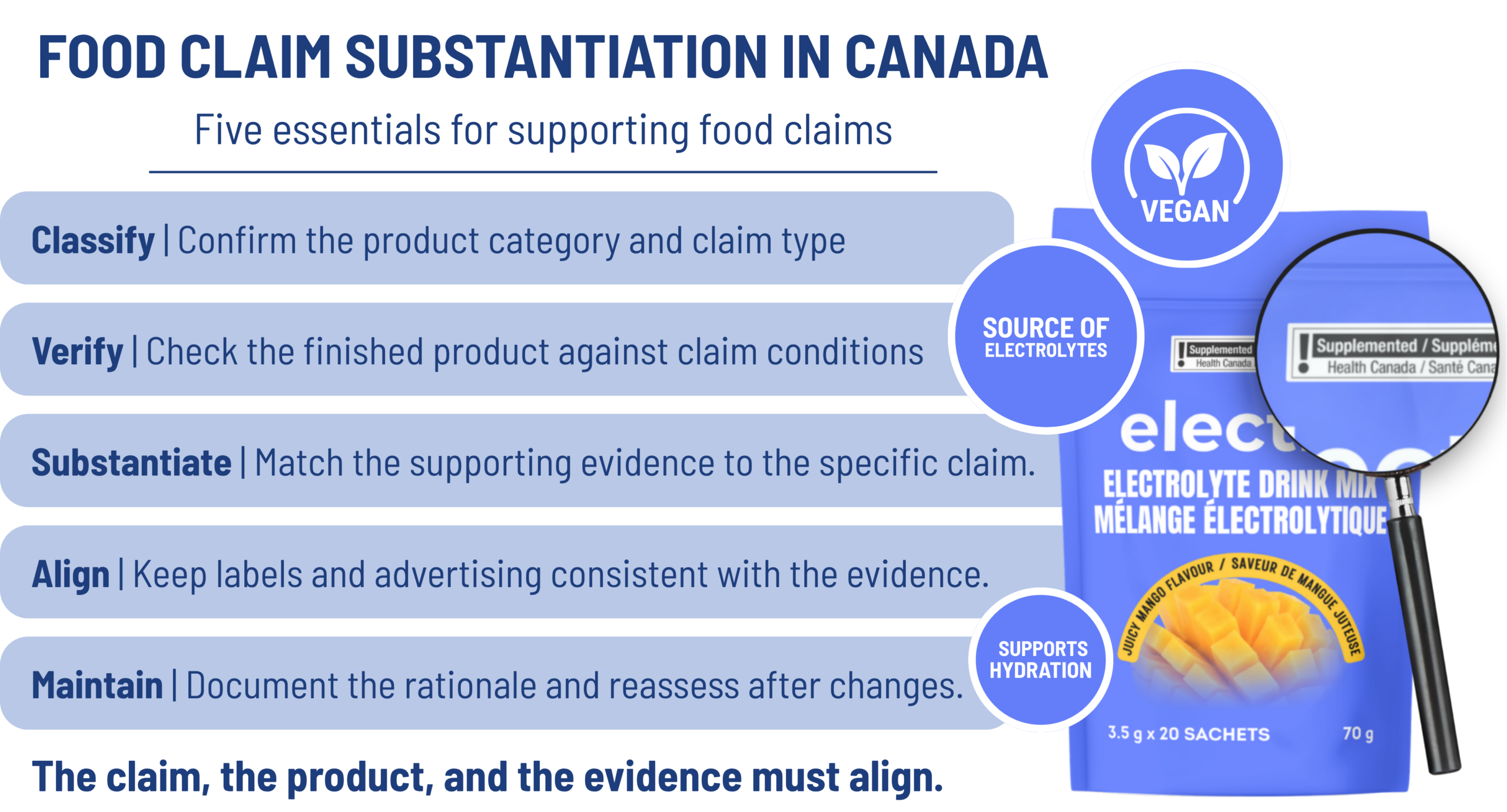
A sound claim substantiation process therefore starts with classifying the finished product and each claim, understanding the applicable requirements, confirming that the product meets relevant conditions, assessing whether the evidence supports the specific representation, and keeping the supporting documentation up to date throughout the product lifecycle.

Show Table of Contents

How to Substantiate Food Claims in Canada

What Is Food Claim Substantiation in Canada?

Food claim substantiation means having the right evidence and documentation to support a claim made about a food. Depending on the claim, this may include:

Canadian Food Claim Regulations: Health Canada and CFIA Requirements

Health Canada establishes many of the requirements that apply to food products, while the Canadian Food Inspection Agency (CFIA) is responsible for enforcing federal food labelling and advertising requirements.

The Competition Act may also apply to food labels and advertising, particularly where claims could be false or misleading. As a result, claim review should look beyond the package and consider the website, retailer listings, promotional materials, social media, and other consumer-facing communications.

Product classification matters because it determines which rules apply, so the correct category should be confirmed before assessing claim compliance and substantiation. Conventional foods and supplemented foods are regulated under the food framework, while natural health products (NHPs) are subject to the Natural Health Products Regulations. Claims can also affect classification and, in some cases, may cause a product that appears to be a food to be treated as an NHP. Supplemented foods must also comply with the Supplemented Foods Regulations, which restrict certain claims and representations.

The same claim or marketing concept may be treated differently depending on the product’s classification. Developing a claim strategy before confirming the classification can lead to unsuitable wording, the wrong evidence approach, or avoidable packaging changes. This article only addresses claims related to conventional food products.

Types of Food Claims in Canada and Their Substantiation Requirements

The type of claim determines what substantiation is required, so it is important to understand the differences between the main types of claims and the specific regulations that apply to each.

Nutrient Content Claims: Permitted Wording and Nutrient Criteria

Nutrient content claims describe the level of a nutrient or other substance in a food, such as “low in sodium,” “source of fibre,” or “reduced in fat.” These claims are subject to specific criteria, including requirements for nutrient levels and permitted wording. The finished product’s nutrition values should be assessed against the applicable requirements in the Table of Permitted Nutrient Content Statements and Claims.  

Method of Production Claims: Natural, Organic, Kosher, and Halal

Method of production claims describe how a food was raised, produced, prepared, or processed. Examples include “natural,” “organic,” “kosher,” “halal,” and “artisan made.” Some have specific regulatory requirements, while others rely more heavily on guidance and general prohibitions against misleading claims.  

Composition and Quality Claims on Food Labels

Composition and quality claims generally describe the content of a food, specific characteristics of the product, or how it differs from other products.

These are divided into several categories:  

Composition Claims

Describe what a food contains, does not contain, or is made from. Examples include “made with real [ingredient],” “vegan,” and “no preservatives.” These claims must accurately reflect the food's composition and must not create a false or misleading impression. Particular care is needed for claims about the presence or absence of ingredients or substances, as factors such as carry-over, processing aids, and naturally occurring substances may need to be considered.

Quality Claims

Describe characteristics or attributes of a food, including claims relating to guarantees, certifications, grades, food safety, or freshness. Examples include “certified,” “premium quality,” and “fresh.” The claim must accurately represent the characteristic being communicated and be supported by relevant documentation.

Comparative Claims

Communicate that a food is different from or has an advantage over another product. These claims should clearly identify the basis of the comparison and be supported by evidence that demonstrates the claimed difference. Comparisons should not create a misleading impression about the product or claim false uniqueness.

Health Claims on Food Labels: Types and Conditions of Use

Health claims can be one of the more complex areas of food labelling because they cover several different types of statements and the requirements depend on what the claim is communicating.

A health claim is broadly defined as any representation on a label or in advertising that states, suggests, or implies a relationship between consuming a food and health. The overall impression of the label matters, including claims that may be implied rather than explicitly stated. Health claims are divided into several main categories: 

Functional
Claims

Describe a specific beneficial effect that a food or an ingredient has on a normal function of the body. Claims should identify a specific physiological effect and be supported by scientific evidence.

They cannot suggest that a food treats, prevents, or mitigates a disease, or modifies normal body functions beyond what would normally be associated with food. Types of function claims: 

Describe the well-established role of a nutrient in maintaining good health or supporting normal growth and development.

For example, a claim may describe calcium’s role in maintaining healthy bones and teeth. Permitted claims are listed in Health Canada’s Table of acceptable nutrient function claims; other claims may also be accepted on a case-by-case basis as new claims are reviewed.

Describe the health effects or benefits of a probiotic microorganism. Health Canada’s Table of Health Claims About Live Microorganisms lists claims that have been reviewed and accepted by Health Canada, along with their conditions of use.

Describe a specific beneficial effect of a food or ingredient on a normal function of the body. Claims reviewed and accepted by Health Canada are listed in the Table of acceptable food or food constituent function claims. New function claims must be supported by scientific evidence before being used on food labels or in advertisements.

Disease Risk Reduction

Link a food to reduced disease or health-condition risk, while therapeutic claims relate to treating, mitigating, restoring, correcting, or modifying a disease, condition, or body function. Foods cannot be labelled or advertised as treating, preventing, or curing a Schedule A.1 disease unless exempted under the Food and Drug Regulations. 

Certain disease risk reduction claims are authorized in Health Canada’s Table of Disease Risk Reduction Claims, subject to conditions of use. Other Schedule A.1 disease claims require mandatory pre-market assessment, while claims about other diseases or conditions may undergo voluntary assessment. Unreviewed claims must be supported by evidence available to the CFIA upon request. 

General Health Claims

Are broader statements that promote healthy eating or provide dietary guidance rather than linking a food to a specific health effect or disease.

For example, "The consumption of [Naming the food] which is low in fat is part of a healthy diet".

These claims must not imply an unsupported specific health benefit or make a disease-related therapeutic representation.

What Evidence Is Required for Food Claim Substantiation in Canada?

There is no single substantiation approach that is appropriate for every food claim. The evidence and documentation needed should be proportionate to the nature, specificity, and regulatory requirements of the representation.

Evidence for Nutrient Content Claims

Evidence for this claim category must consider the following substantiation: 

Nutrient content claims are generally straightforward to substantiate. Only permitted claims and wording may be used, and the finished product must meet the applicable regulatory criteria. A record demonstrating compliance with these requirements should be maintained internally so that the basis for the claim can be provided if requested by the CFIA.

Evidence for Composition and Quality Claims

Evidence for this claim category must consider the following substantiation: 

Evidence for Method-of-Production Claims

Evidence for this claim category must consider the following substantiation: 

Some composition, quality, and method-of-production claims are also subject to specific regulatory requirements or established criteria. Where clear regulatory criteria do not apply, the claim should be supported by appropriate product, production, and supply-chain documentation. Third-party certifications, audits, and other independent verification can also provide useful support for these types of claims.

Evidence for Function Claims

Evidence for this claim category must consider the following substantiation: 

Evidence for Disease Risk Reduction or Therapeutic Claims

Evidence for this claim category must consider the following substantiation: 

Evidence for General Health Claims

Evidence for this claim category must consider the following substantiation: 

Health claims that have not been specifically reviewed and accepted by Health Canada, substantiation should be based on a systematic, comprehensive, and transparent assessment of the scientific evidence. Manufacturers must have appropriate scientific evidence to support new health claims. The evidence must apply to the target population and support both the claimed effect and the amount of food or food constituent needed to achieve it. The required amount must also be reasonably consumable as part of a healthy, balanced diet, based on the food’s reasonable daily intake (RDI).

Health Canada's guidance identifies at least two independent, well-designed studies as necessary to demonstrate reproducibility, while emphasizing that the relevance, quality, and strength of the evidence are more important than the number of studies. 

How to Substantiate Food Claims in Canada: Seven Steps

1. Confirm the product classification

Determine whether the product is a conventional food, supplemented food, NHP, or another regulated product type. Classification affects the applicable requirements, available claims, labelling requirements, and potential pre-market requirements. 

2. Capture every express and implied claim

Create an inventory covering the package, product name, graphics, website, retail listings, sales materials, testimonials, influencer content, and other advertising. Review the overall impression rather than assessing each representation in isolation.

3. Classify each representation

Identify whether each representation is a nutrient content, composition, quality, method-of-production, comparative, nutrient function, other function, disease risk reduction, therapeutic, general health, or other type of claim. A single representation may raise more than one regulatory consideration. 

4. Establish the legal and evidentiary basis

For a prescribed or accepted claim, verify the applicable wording and conditions of use. For a claim without specific prescribed requirements, determine what evidence is needed to demonstrate that the representation is truthful and not misleading. Determine whether Health Canada assessment or a regulatory amendment is required before use. 

5. Confirm that the finished product qualifies

Assess the claim against the product as sold and consumed. Depending on the claim, consider serving size, reference amount (RA), directions for use, nutrient levels, processing, target population, and reasonably foreseeable consumption. 

6. Align the claim with the label and advertising

Verify that the claim is consistent with the ingredient list, nutrition information, quantitative declarations, front-of-package nutrition symbol requirements, and any applicable supplemented food caution statements. Where applicable, qualifiers or disclaimers should be clear and sufficiently prominent so that the overall message is not misleading. 

7. Build and maintain a claim substantiation dossier

The dossier should make the basis for the claim readily traceable. Depending on the representation, it may include: 

Common Food Claim Substantiation and Compliance Risks

Broad or Vague Food Health Claims

Claims should clearly state a specific, scientifically supported physiological effect associated with good health or performance. Broad or vague claims, such as “supports immune function,” are generally not acceptable and should not imply that a food is healthier or nutritionally superior to similar foods.

Ingredient Evidence That Does Not Support the Finished Food Product

Evidence for an ingredient does not automatically substantiate the same effect in every finished product. Dose, source, processing, formulation, matrix, stability, and conditions of consumption can affect relevance.

Changes to Prescribed Food Claim Wording

A permitted claim is tied to defined conditions. Paraphrasing it into a stronger or broader promise can move the representation beyond the authorized basis.

Misleading Headlines and Inadequate Food Claim Disclaimers

Fine print does not necessarily cure a misleading headline, image, testimonial, or dominant message. The complete presentation must be supportable.

Unreviewed Food Claims in Digital and Third-Party Content

Product pages, advertisements, retailer copy, social captions, video demonstrations, and influencer statements can create regulated representations. Claims governance should address every channel through which the business controls or authorizes the message. 

Outdated Food Claim Evidence After Product Changes

A supplier substitution, reformulation, new serving size, revised process, updated study, or packaging redesign may affect whether the claim remains accurate. Claim approval should be connected to formal change control. 

Building Food Claims into Product Commercialization

Claim strategy is strongest when it begins before final formulation and packaging. Early review can identify which benefits are legally available, what compositional thresholds must be met, whether a study is necessary, and which records will be required at launch. 

This approach also helps regulatory, research and development, quality, marketing, and creative teams work from the same approved claim architecture. Rather than weakening a campaign after the artwork is complete, the business can build marketable language around claims the product can substantiate. 

Final Remarks

Food claim compliance in Canada depends on alignment. The product classification, formula, evidence, prescribed conditions, label, and advertising must tell the same defensible story.

A claim may be only a few words on the package, but the substantiation behind it can involve regulatory interpretation, analytical data, scientific review, production controls, and ongoing change management. Businesses that address those elements early are better positioned to preserve compelling marketing language, reduce rework, and respond confidently if evidence is requested.

Food Claim Substantiation Services in Canada: How SNI Can Help

Source Nutraceutical, Inc. (SNI) helps food and supplemented food businesses translate product evidence into commercially useful, compliant claims. With more than 20 years of consulting experience and over 100 years of collective regulatory expertise, our multidisciplinary team connects regulatory strategy, scientific substantiation, clinical research, label compliance, and creative execution.

Launch with Evidence

Whether you are evaluating a new health claim, validating a nutrient content statement, reviewing “free-from” language, or preparing a claim substantiation dossier, SNI can help identify the most defensible route before claims reach the market. 

Planning a Canadian product launch or revisiting an existing claim? Contact SNI to turn your evidence into a clearer path to market. 

Book an introductory call using the following form:

Great! We’ve received your information. Our team will reach out shortly.

Food Claim Substantiation in Canada: FAQ

No. Clinical trials are not required for most food claims. Many claims can be substantiated by demonstrating that the product meets applicable regulatory criteria, supported by formulation, specifications, analytical data, or other relevant documentation.

For certain health claims, Health Canada has already evaluated and accepted specific claim wording and conditions of use, which may be used on products that meet those conditions without conducting new clinical trials.

Health claims that have not been evaluated and accepted by Health Canada may require a more comprehensive scientific assessment, including relevant human evidence, depending on the nature of the claim and the evidence needed to substantiate it. 

Not automatically. The evidence must be relevant to the ingredient source, dose, formulation, food matrix, target population, endpoint, and conditions of use. Material differences between the research and the marketed product can weaken the substantiation. 

No. Pre-market Health Canada review is not required for every food health claim. Some claims have already been reviewed and accepted by Health Canada and may be used when the specified wording and conditions of use are met.

Claims involving Schedule A.1 diseases that have not been previously evaluated require mandatory pre-market assessment and a regulatory amendment before use. Other health claims are subject to voluntary pre-market assessment. Unreviewed claims must still have supporting evidence available to the CFIA upon request. 

Yes. Although these claims may not all have prescribed definitions under the Food and Drug Regulations, they remain subject to the requirement that food representations be truthful and not misleading. The necessary substantiation depends on the claim and may include ingredient documentation, supplier controls, cross-contact procedures, audits, certification, or testing.

Yes. Canadian requirements apply to food advertising as well as labels. Website copy, digital ads, social content, testimonials, images, and other representations should be assessed collectively for the overall impression they create. 

Share the Post:

Related Posts

How are Protein Powders Regulated in Canada?

How are Protein Powders Regulated in Canada?

Protein powders sold in Canada may be regulated as conventional foods, supplemented foods or natural health products (NHPs). Learn how classification affects ingredients, claims, licences, labels, quality controls and importation requirements.
Canada Updates Caffeinated Beverage Rules

Canada Updates Caffeinated Beverage Rules

Health Canada has increased the permitted amount of fruit and vegetable juice in certain caffeinated supplemented beverages from less than 25% to no more than 30%. The change provides greater formulation flexibility, although existing labelling and representation restrictions remain in place.

The content on this website, including information presented in this post, is provided for general informational purposes only and does not constitute legal, regulatory, or professional advice. While efforts are made to ensure accuracy, laws and regulations vary by jurisdiction and may change over time. Readers should not rely on this information as a substitute for advice from qualified legal or regulatory professionals. We disclaim any liability for actions taken based on this content, and users are encouraged to seek guidance specific to their circumstances.

Join Our Newsletter

Loading...