
This article explains how to determine which Canadian Nutrition Facts table (NFt) format applies to a prepackaged food product, including when an NFt is required, how exemptions may be lost, how available display surface (ADS) affects format selection, and why bilingual, simplified, dual, aggregate, and small-package requirements must be reviewed before a label is finalized.
- Do You Need a Nutrition Facts Table (NFt)?
- How Does Available Display Surface (ADS) Affect the Nutrition Facts Table (NFt)?
- Which Package Areas Are Excluded from Available Display Surface (ADS)?
- How Is Available Display Surface (ADS) Calculated for Standard Packages?
- How Is Available Display Surface (ADS) Determined for Irregular Packaging?
- How Are Decorative and Unusually Shaped Containers Assessed?
- Do Tags Increase the Available Display Surface (ADS)?
- Why Is an Accurate Available Display Surface (ADS) Calculation Important?
- Which Canadian Nutrition Facts Table (NFt) Format Applies to Your Product?
- When Are Dual or Aggregate Nutrition Facts Tables (NFts) Required?
- Common Nutrition Facts Table (NFt) Mistakes That Delay Product Launches
- Final Remarks
- FAQ
Do You Need a Nutrition Facts Table (NFt)?
Under Canada’s Food and Drug Regulations, most prepackaged foods must display a Nutrition Facts table (NFt). However, determining whether an NFt is required is not always as straightforward as confirming that a product is prepackaged. The applicable requirements depend on the product category, how the food is packaged and sold, the available display surface (ADS), and whether nutrition or health-related claims appear on the label or in associated advertising.
Certain products are also governed by specialized nutrition labelling provisions and therefore do not use the standard NFt or the prescribed heading “Nutrition Facts.” These include formulated liquid diets, infant formula, human milk fortifiers, meal replacements, nutritional supplements, and foods represented for use in very low energy diets. Although these products must communicate prescribed nutrition information, the information is presented according to the requirements specific to the applicable food category rather than through a conventional NFt.
Supplemented foods also follow a separate framework. These products are generally required to display a Supplemented Food Facts table (SFFt), which includes the conventional nutrition information required for foods together with applicable supplemental ingredient declarations. As a result, a standard NFt cannot be substituted for the prescribed SFFt on a supplemented food.
Foods That Are Always Exempt from an Nutrition Facts Table (NFt)

A limited number of prepackaged foods are unconditionally exempt from displaying an NFt. These foods cannot lose their exemption because of claims or other representations made on the label or in advertising.
The exemption applies to categories such as fresh fruits and vegetables, prepackaged individual portions intended solely to be served by restaurants or other commercial enterprises, and certain milk and cream products sold in refillable glass containers.
Foods with an ADS of less than 15 cm² may also qualify for an unconditional small-package exemption. This differs from other small-package provisions that may provide an alternative method of making nutrition information available rather than removing the requirement entirely.
Foods That Are Conditionally Exempt from an Nutrition Facts Table (NFt)

A broader group of foods is normally exempt from displaying an NFt but can lose that exemption depending on how the product is represented or marketed. These conditional exemptions commonly apply to products for which all core nutrients may be declared as zero, beverages containing more than 0.5% alcohol, and raw single-ingredient meat, poultry, marine animal, or freshwater animal products.
Conditional exemptions may also apply to foods prepared and sold only at the same retail establishment, foods sold directly by the person who prepared them at locations such as farmers’ markets, and individual servings sold for immediate consumption. Certain foods packaged and sticker-labelled at the retail establishment where they are sold may also qualify where the ADS is less than 200 cm².
These exemptions reflect the product’s composition, method of sale, packaging format, or limited retail distribution. They should not be treated as permanent classifications, particularly where the product’s label, advertising, or sales model may change.
When Is a Nutrition Facts Table (NFt) Exemption Lost?

A conditionally exempt food will generally lose its exemption when the label or manufacturer-directed advertising includes a nutrient content claim, health claim, nutrient function claim, biological role claim, or another representation that specifically refers to the product’s energy value or nutrient content.
For example, a food that would otherwise be exempt may become subject to full nutrition labelling requirements when it is described as “high in fibre,” “low in sodium,” or as supporting a particular physiological function. Once the exemption is lost, the NFt must be included in the prescribed format and may need to declare additional nutrients connected to the claim.
The exemption assessment must therefore consider more than the physical label. Claims appearing on websites, digital advertising, point-of-sale materials, social media, and other manufacturer-controlled communications can also affect the product’s nutrition labelling obligations.
From a compliance perspective, NFt applicability should be assessed before artwork is finalized and revisited whenever the formulation, claims, packaging, ADS, sales channel, or intended product positioning changes. A food that qualifies for an exemption at the beginning of product development may require a complete NFt by the time it is marketed.
How Does Available Display Surface (ADS) Affect the Nutrition Facts Table (NFt)?
The size and format of an NFt are determined, in part, by the package’s ADS. ADS is therefore one of the first measurements that should be confirmed when developing or revising a Canadian food label.
ADS generally refers to the total package area that can physically carry labelling information. This includes both unused space and surfaces already occupied by mandatory, optional, or promotional content. A company cannot reduce the calculated ADS simply by filling the package with branding, claims, imagery, or other label information.
The ADS calculation is used to determine which prescribed NFt formats may be applied. In general, the selected format must fit within the permitted proportion of the ADS while meeting the applicable requirements for dimensions, spacing, type size, and presentation.
Which Package Areas Are Excluded from Available Display Surface (ADS)?

Not every part of a package is considered suitable for carrying nutrition information. Areas that cannot reasonably accommodate legible and accessible labelling may be excluded from the ADS calculation.
This may include package areas that are destroyed when the product is opened, such as certain tear strips or tamper-evident bands. Bag closures, gathered ends, ridges, eye spots, and certain small or irregular continuous surfaces may also be excluded where they cannot support the required information.
Other exclusions may apply to UPC symbols, certain lids, highly curved surfaces, and windows or transparent packaging areas, depending on the package design and how those areas are used. A continuous surface of 12 cm² or less may generally be excluded where it is too small to accommodate even the smallest permitted NFt and does not already contain printed labelling information.
These exclusions are package-specific. The presence of a curve, window, closure, or raised feature does not automatically remove the entire area from ADS. Manufacturers must assess whether required information can be physically applied, read, and easily viewed under customary conditions of purchase.ng of product development may require a complete NFt by the time it is marketed.
How Is Available Display Surface (ADS) Calculated for Standard Packages?

For conventional packaging formats, the ADS calculation is generally based on the measurable surface area available for labelling. Rectangular cartons, boxes, uniformly shaped jars, and conventional bottles are typically more straightforward because their usable surfaces can be measured using standard geometric calculations.
The calculation should account for all qualifying package surfaces, including areas already used for other label content. Depending on the package, the bottom may also form part of the ADS and may be used for the NFt, provided the applicable presentation requirements are met. The NFt must appear on one continuous surface of the ADS.
How Is Available Display Surface (ADS) Determined for Irregular Packaging?

Irregular packaging, such as bottles, tapered jars, and containers with complex contours can make it difficult to determine the exact surface area available for labelling. For qualifying bottles and jars, manufacturers may use the optional ADS-by-volume method instead of directly measuring each irregular surface.
Under this approach, ADS is determined using the internal volume of the container and the applicable regulatory calculation. This method can provide a more consistent basis for selecting an NFt format when conventional surface measurements would be impractical or unreliable.
The optional method should not be used simply because a package contains some curved surfaces. Its applicability must be assessed against the type and configuration of the container.
How Are Decorative and Unusually Shaped Containers Assessed?

For ornamental or decorative containers, ADS is based on the surfaces on which mandatory information can reasonably be applied and viewed. Decorative projections, sculpted elements, deep recesses, or other features that cannot support legible labelling are generally not treated as usable display surface.
A similar assessment applies to containers that are unusually shaped, such as those with raised designs, unusual contours, or uneven surfaces. The relevant question is not whether a physical surface exists, but whether it can practically accommodate label information that remains legible and easily visible to the purchaser.
This distinction is particularly important for premium, seasonal, or gift-oriented packaging, where a large overall container may have relatively little usable space for regulatory information.
Do Tags Increase the Available Display Surface (ADS)?

Attaching a tag to a package does not automatically increase its ADS. Where information can be physically applied to the package itself, the ADS is generally based on the available package surface rather than the dimensions of a voluntarily added tag.
However, where a label cannot physically be applied to the package, or where information cannot be legibly set out and easily viewed on the package under customary purchasing conditions, both sides of an attached tag may form the ADS.
Manufacturers should therefore avoid relying on a tag as a means of selecting a smaller NFt unless the packaging genuinely meets the applicable conditions.
Why Is an Accurate Available Display Surface (ADS) Calculation Important?

ADS directly affects the NFt format hierarchy and the minimum size that must be used. An underestimated ADS calculation may lead to the selection of an NFt that is smaller than permitted, creating a labelling non-compliance. Conversely, an overestimated calculation may result in an unnecessarily large table that limits the space available for other mandatory information, branding, and claims.
The ADS assessment should therefore be completed using the final package specifications, including its dimensions, shape, closures, windows, seams, decorative features, and intended label placement. It should also be revisited when the package format changes, even if the food formulation and nutrition information remain the same.
For small packages, ADS may also affect whether specialized formatting or an exemption is available. For example, a package with an ADS of less than 100 cm² may, under prescribed conditions, omit the NFt when the label explains how consumers can obtain the nutrition information. Packages with an ADS of less than 15 cm² may qualify for a separate exemption.
Which Canadian Nutrition Facts Table (NFt) Format Applies to Your Product?
Once the ADS has been determined, the NFt format can be selected. The chosen format must be the largest permitted format that fits on a continuous surface of the label and does not exceed 15% of the ADS. Each NFt format has strict graphic requirements that are predetermined and must be respected.
Nutrition Facts Table (NFt) Format Selection
When choosing a NFt format, two key factors must be considered: whether the format fits on a continuous surface of the label and whether it occupies no more than 15% of the ADS.
The standard format should always be assessed first. If it can fit within the available space while meeting the ADS requirement, it should generally be used. If the standard format does not fit, manufacturers can then work through the permitted alternate formats in the order set out by the regulations, considering options such as narrow, horizontal, or linear formats where applicable.
In practice, this means NFt selection should not begin with the smallest available format. Start with the standard format, confirm whether it fits on a continuous surface, calculate how much of the ADS it occupies, and only move to an alternate format if the standard version cannot be accommodated
Common NFt formats include the following:
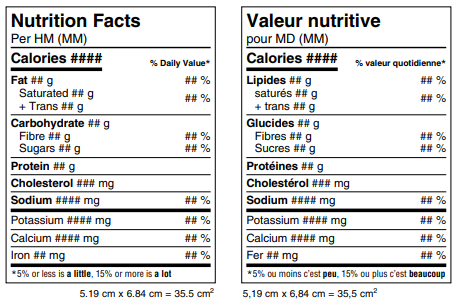
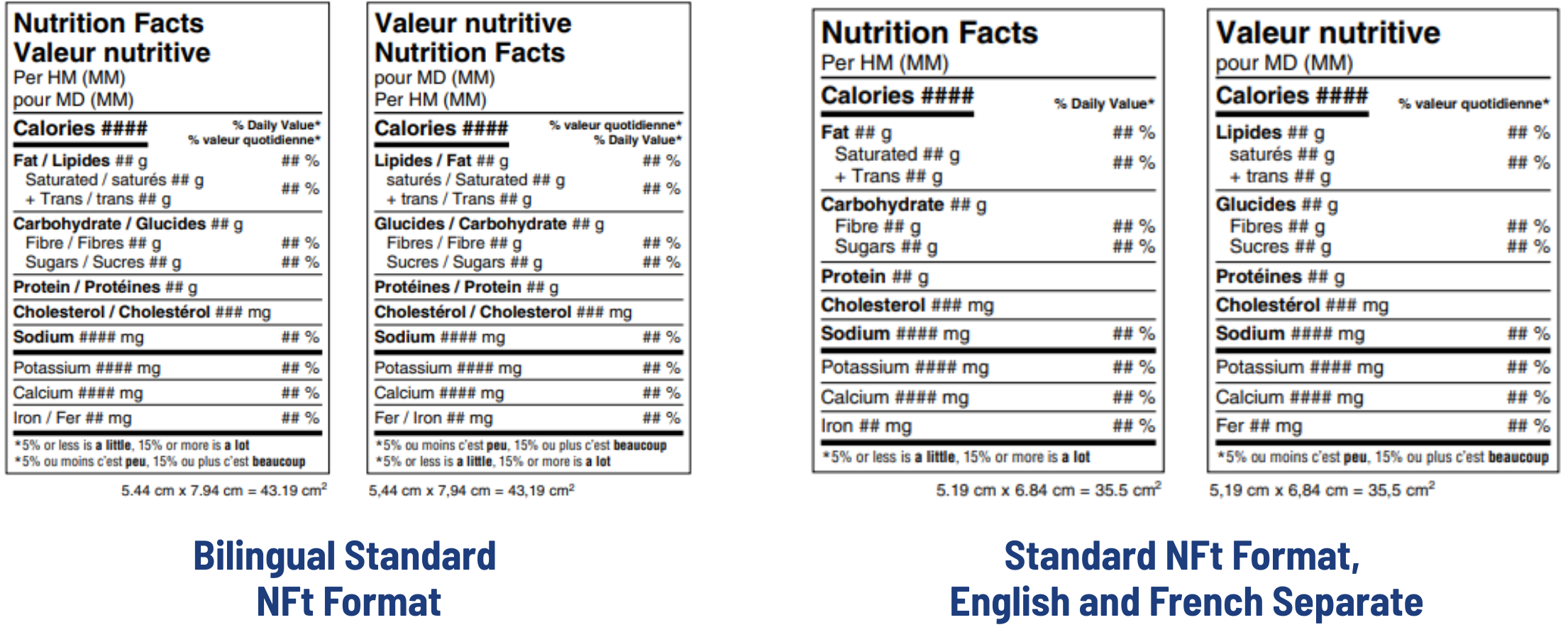
Standard Nutrition Facts Table (NFt) Format
The standard NFt format is the most commonly used format and should be selected whenever it can be accommodated. The largest standard format that fits on a continuous surface and does not exceed 15% of the ADS must be used whenever possible.
If the standard format cannot be accommodated, alternative formats may be considered in the following order:
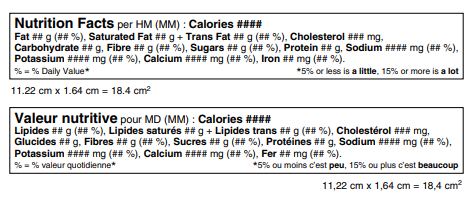
Horizontal Nutrition Facts Table (NFt) Format
May be used if the standard format does not fit on any continuous surface or would exceed 15% of the ADS.
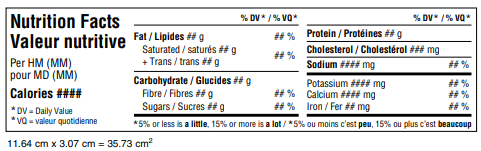
Linear Nutrition Facts Table (NFt) Format
The linear format may be used only when neither the standard nor horizontal format can be accommodated due to package space limitations.
Choosing a smaller or alternative format when a larger permitted format would fit is not an acceptable approach. Format selection must always follow the prescribed order.
Bilingual Requirements for Nutrition Facts Tables (NFts)
Nutrition information must be presented in both English and French. The format selected determines how the bilingual information is displayed.
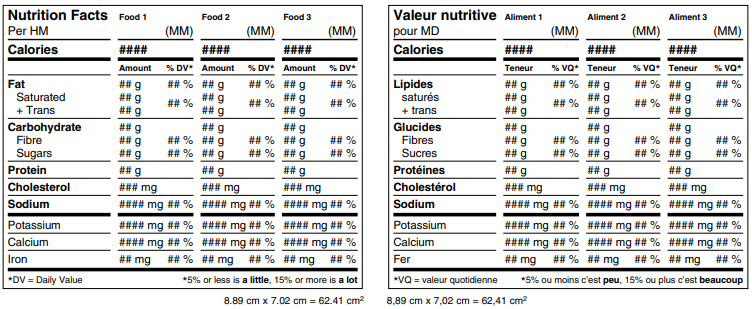
The standard and horizontal NFt formats may be presented either as a single bilingual table containing both languages or as two separate tables, one in English and one in French. By contrast, the linear format must be displayed as separate English and French tables.
For packages with limited ADS, certain narrow unilingual NFt formats may also be permitted, provided the product meets the applicable regulatory conditions.
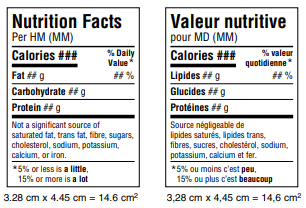
Simplified Nutrition Facts Table (NFt)
Some products may qualify to use the simplified NFt format when six or more core nutrients can be declared as “0.” Some single-serving containers may also be eligible for a specific simplified format table. Core nutrients that cannot be declared as “0” are generally required in the simplified NFt. Additional nutrients may be required when claims are present on the label.
The simplified NFt format is available in standard, horizontal, and linear versions. The same format selection rules apply: the largest permitted format that fits on a continuous surface and does not exceed 15% of the ADS must be used.
Nutrition Facts Table (NFt) for Small Packages
Packages with an ADS of less than 100 cm² may qualify for an exemption from displaying an NFt, provided specific regulatory conditions are met. When an exemption applies, the label must provide information on how consumers can obtain the required nutrition information, such as a telephone number or mailing address.
This exemption can help accommodate products with limited label space. However, it may no longer apply when certain claims are made on the label, such as a nutrient content claim, health claim, or function claim. In these cases, an NFt may be required.
When Are Dual or Aggregate Nutrition Facts Tables (NFts) Required?
Certain products require dual or aggregate NFt formats when nutrition information must be provided for more than one food state, product, or serving scenario.
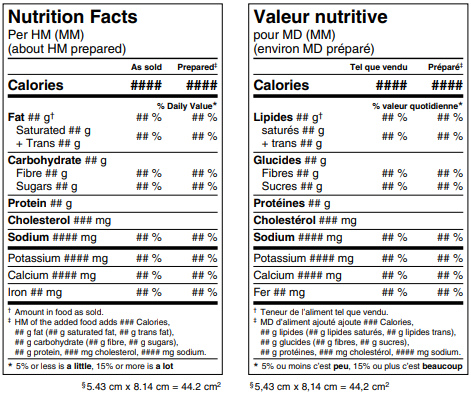
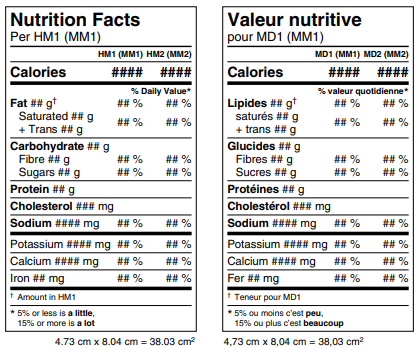
Common Dual-Format Nutrition Facts Tables (NFts):
- As sold vs. prepared: Provides nutrition information for both the product as sold and after preparation according to label directions. This format is always optional.
- Different amounts of food: Provides nutrition information for more than one amount or unit of measurement of a food, such as 1 slice and 2 slices of bread. This format is always optional.
Common Aggregate-Format Nutrition Facts Tables (NFts):
- Assortments of foods: Used for prepackaged products containing an assortment of similar foods where nutrition information differs between individual items.
- This format is optional when a typical serving includes more than one food (for example, a box of assorted chocolates or a tray of mixed nuts).
- This format is required when a typical serving consists of only one food item (for example, a variety pack of granola bars or chocolate bars).
- Foods intended to be eaten together: Used for packages containing separately packaged foods or ingredients meant to be consumed together, such as a cheese and cracker snack kit or taco kit. This format is always optional.
Common Nutrition Facts Table (NFt) Mistakes That Delay Product Launches
Incorrect Available Display Surface (ADS) Calculations
A common error is calculating the ADS incorrectly. ADS must be based on the entire labelling surface of the package, not just the area the manufacturer plans to use. Only specific excluded areas may be omitted.
Incorrect Nutrition Facts table (NFt) format selection
Some manufacturers choose a smaller NFt format for design or space reasons, but this is not compliant. The format must be based on the largest format that fits on a continuous surface and uses less than 15% of the ADS, unless an exception applies.
Improper Bilingual Presentation
Mandatory nutrition information must appear in both English and French. This can be done with one bilingual NFt or two separate NFts, but the required information must always be bilingual.
Implications of Using an Alternative Nutrition Facts Tale (NFt) Format Without Meeting the Conditions
Simplified, aggregate, dual, linear, and other alternative NFt formats cannot be used for convenience alone. Each has specific conditions for use. Applying one of these formats without first confirming that the package and product qualify is a common error.
Final Remarks
Determining the correct Canadian NFt format is not simply a design decision. It requires a step-by-step assessment of whether an NFt is required, whether any exemption applies, how the product is marketed, and how much ADS the package provides.
Because claims, package size, bilingual requirements, and format hierarchy can all affect the final label, NFt decisions should be confirmed before artwork is finalized or sent to print. A format that appears acceptable from a layout perspective may still be non-compliant if it does not follow the prescribed order or fit within the applicable ADS requirements.
For manufacturers, importers, and brand owners, the safest approach is to review NFt obligations early in the product development or label revision process. Confirming the correct table type, format, language presentation, and supporting calculations in advance can help reduce the risk of redesigns, launch delays, and regulatory non-compliance in the Canadian market.
How SNI Supports Canadian Food Label Compliance
Selecting a correct NFt format can be challenging. SNI can help you accurately calculate the ADS, determine the correct NFt format, and navigate all aspects of Canadian food labelling requirements. We also assist with converting U.S. and other foreign NFts, as well as complete product labels, into Canadian-compliant formats.
Through our regulatory label reviews, we identify potential compliance issues before labels are finalized, helping reduce the risk of costly revisions, production delays, and regulatory non-compliance.
Contact SNI before your labels go to print to ensure your products meet Canadian food labelling requirements.

Book an introductory call using the following form:
FAQ
Can I use a U.S. Nutrition Facts Panel (NFP) in Canada?
No. Only the Canadian Nutrition Facts table (NFt) may be used on foods sold or advertised in Canada. U.S. or other foreign nutrition panels are not permitted, even if they are displayed alongside the Canadian NFt.
I use a sticker to label my product. Is the sticker area considered the available display surface (ADS)?
No. The ADS is based on the entire available labelling surface of the package or container, not only the area covered by the sticker.
Can I use a linear NFt?
Only if the regulatory conditions are met. The linear NFt format may be used only when neither the standard nor the horizontal format fits on any continuous ADS of the package, or when those formats would occupy more than 15% of the ADS.
Can I use a single standard NFt for a multi-flavour variety pack by combining the nutrition values of all flavours?
Only in specific cases. A standard NFt may be used when a serving consists of multiple items from the assortment (e.g., a box of chocolates) or when all items have identical nutrition values (e.g., a multi-pack of frozen popsicles).
When a prepackaged product contains an assortment of foods and a serving consists of one individual item, with different serving sizes, calories, or core nutrient values among the items, an aggregate NFt is required (for example, a variety pack of granola bars or chocolate bars).
Are coffee and tea exempt from displaying a NFt in Canada?
Not specifically. Coffee and tea are not exempt simply because of their product category. However, products for which all mandatory nutrients and calories can be declared as “0” are exempt from displaying an NFt. Many coffee and tea products have historically met this condition.
Following the 2016 amendments to the nutrition labelling regulations, potassium became a mandatory nutrient in the NFt. As a result, some coffee and tea products no longer qualify for the exemption because their potassium content cannot be declared as “0” and must therefore be included in a NFt.
The content on this website, including information presented in this post, is provided for general informational purposes only and does not constitute legal, regulatory, or professional advice. While efforts are made to ensure accuracy, laws and regulations vary by jurisdiction and may change over time. Readers should not rely on this information as a substitute for advice from qualified legal or regulatory professionals. We disclaim any liability for actions taken based on this content, and users are encouraged to seek guidance specific to their circumstances.