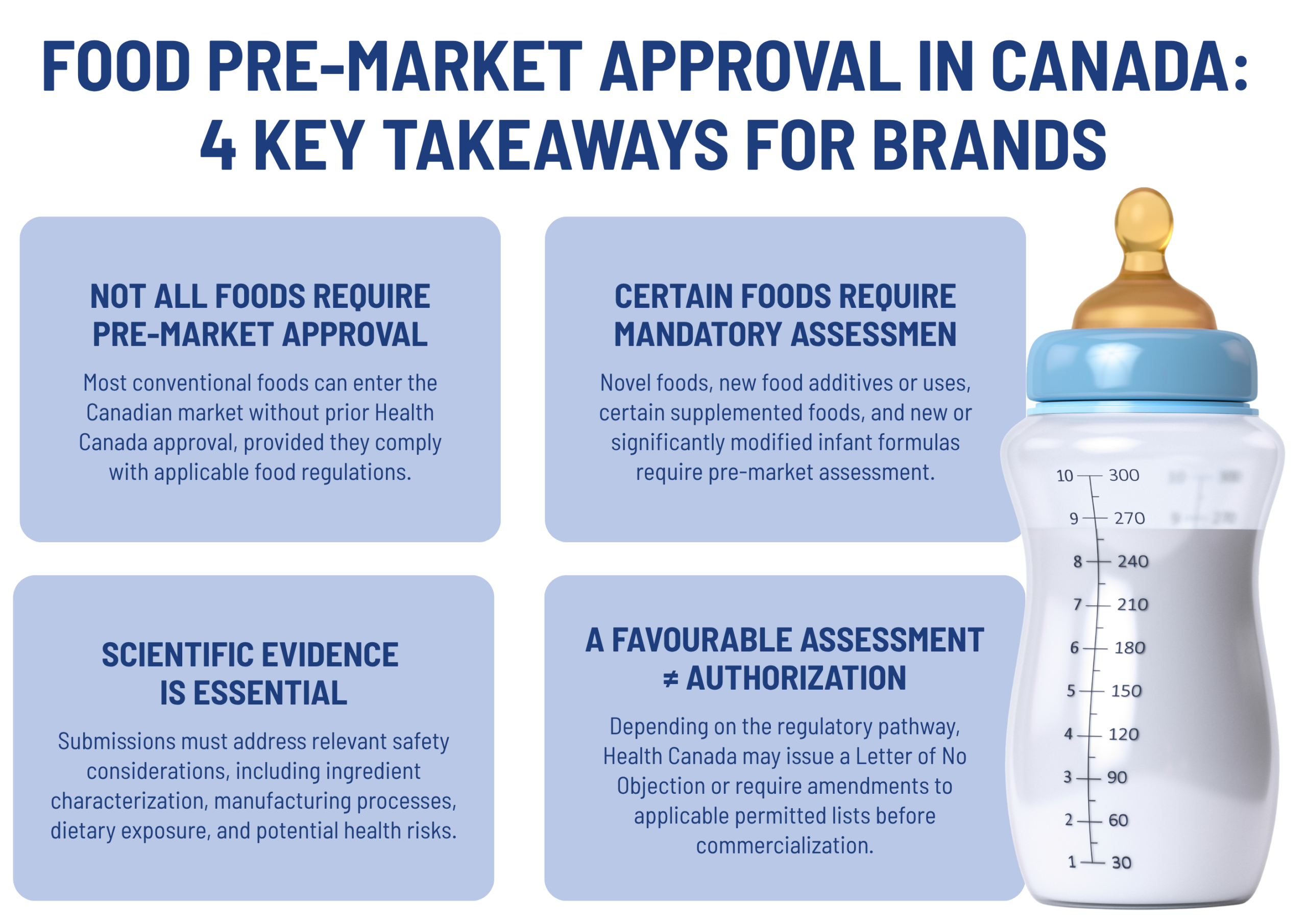
Most foods do not require Health Canada approval before entering the Canadian market. However, certain products, ingredients, and proposed uses are subject to mandatory pre-market assessment because they fall outside an already established regulatory permission or raise questions that must be resolved before sale.
Canada’s mandatory food pre-market submission pathways apply to novel foods, new food additives and new uses of permitted food additives, new or modified infant formulas and human milk fortifiers, new infant formula ingredients, and proposed changes to the permitted supplemental ingredients or food categories used under the supplemented foods framework, and certain health claims referring to diseases listed in Schedule A.1 of the Food and Drugs Act.
The correct pathway depends on what is new: the food itself, an ingredient, a manufacturing process, a technological purpose, a condition of use, or a regulated food category. Establishing this distinction early can prevent a company from investing in a dossier that answers the wrong regulatory question.
Food pre-market approval in Canada refers broadly to the regulatory processes through which Health Canada evaluates certain foods, ingredients, uses, or health claims before they may be legally sold. Depending on the pathway, the regulatory mechanism may be a mandatory notification, an authorization request, or a submission seeking a change to a document incorporated by reference into the Food and Drug Regulations.
The term “approval” is useful in general discussion, but it does not describe every outcome precisely. For example:
Health Canada’s Food and Nutrition Directorate conducts the pre-market scientific assessment. The Canadian Food Inspection Agency (CFIA) is responsible for verifying compliance and enforcing applicable food requirements in the marketplace, but it does not issue Health Canada’s pre-market decisions.
The Food and Drug Regulations establish different pre-market requirements for different product categories. A mandatory submission may apply when a business proposes to market:
Not every unfamiliar ingredient requires authorization. A substance may already be permitted for the intended food and use, may be non-novel, or may be regulated through another pathway. Conversely, an ingredient that is permitted in one food category or at one level is not automatically permitted in another.
Not every unfamiliar ingredient requires authorization. A substance may already be permitted for the intended food and use, may be non-novel, or may be regulated through another pathway. Conversely, an ingredient that is permitted in one food category or at one level is not automatically permitted in another.
Before dossier development begins, the company should establish the identity, purpose, source, manufacturing process, proposed food categories, use level, target population, and anticipated intake of the ingredient or food. These facts determine which regulatory questions must be answered.
Health Canada’s submission management process for food additives, novel foods, and infant formulas generally involves administrative verification, scientific review, and a decision. The evidence requirements and final regulatory action vary by pathway.
Begin by comparing the proposed product or use against the Food and Drug Regulations, current incorporated-by-reference lists, and applicable Health Canada guidance.
For a potential novel food or food ingredient, a company may request a novelty determination before preparing a full novel food notification. Health Canada's novelty determination process provides a written response within 60 calendar days of receiving a request. Where additional information or clarification is required, the administrative process may affect when a determination can be completed. A determination that the product is novel means it requires pre-market safety assessment before sale. A non-novel determination does not exempt the product from other Canadian food requirements.
For food additives, review all 15 Lists of Permitted Food Additives. Permission is tied to the additive, source where applicable, technological purpose, food category, maximum level of use, and any additional conditions. A submission is required when the proposed use falls outside those permissions.
A pre-submission consultation is optional but can be valuable when the pathway, data requirements, or study strategy is uncertain. Health Canada may clarify procedural or technical expectations, identify preliminary issues, and discuss questions presented by the applicant.
The consultation should be focused. A useful package typically includes:
A consultation does not constitute authorization or guarantee a favourable decision. It can, however, help ensure that the resulting dossier is designed around the appropriate safety questions.
The submission must follow the applicable Health Canada guidance and checklist. A generic technical file is rarely sufficient because the relevance of each evidence category depends on the proposed food, ingredient, process, and exposure.
Common submission components may include administrative forms and a cover letter, together with substance or product identity and characterization, composition and specifications, and a description of the manufacturing process and quality controls. Analytical methods and representative batch data help characterize the material addressed by the submission.
The dossier may also need to describe proposed uses, use levels, and food categories and provide dietary exposure estimates. Supporting evidence may address toxicological, microbiological, nutritional, and allergenicity considerations, as applicable, as well as efficacy information where required for a food additive’s technological purpose. Proposed conditions of use and risk-management measures should be accompanied by a clear assessment demonstrating how the evidence supports safety.
Since September 23, 2024, the applicable completed checklist must be included with a food additive submission. It should function as a completeness control, not as a substitute for a coherent scientific dossier.
Pre-market submissions for food additives, novel foods, supplemented foods, infant formulas, new infant formula ingredients, and human milk fortifiers are filed electronically using Health Canada's online application form. Other requests, including novelty determinations, health claim submissions, and pre-submission consultation requests, must be directed to Health Canada's Submission Management and Information Unit (SMIU) through the designated email channel. Applicants should verify the applicable submission procedure before filing.
Health Canada first verifies whether the package contains the necessary administrative information. An acceptable submission then proceeds to scientific review.
Reviewers may request clarification, revised exposure estimates, additional analytical information, or changes to the requested conditions of use. Responses should directly address each question, distinguish new material from previously filed information, and preserve version control across the dossier.
A favourable scientific conclusion does not always mean that immediate sale is permitted. For food additives and supplemented food submissions, the relevant incorporated-by-reference list must be modified before the new use, ingredient, condition, or category becomes legally available. Market-entry planning should therefore account for both scientific assessment and the pathway-specific implementation step.
A food additive submission in Canada is required to request permission for a new food additive other than a food enzyme, an extended or modified use of an already permitted food additive, or a new or modified food enzyme source or use.
The first question is whether the substance performs a food additive function and whether the proposed use is already covered by the Lists of Permitted Food Additives. Processing aids and incidental additives require separate analysis because not every substance used during food manufacturing is regulated as a food additive.
The dossier should define the additive sufficiently to connect the submitted safety evidence to the commercial material. Depending on the substance, this may include its chemical or common name, synonyms, structural information, source organism, manufacturing process, composition, purity criteria, impurities, contaminants, residual solvents, microbiological specifications, and validated analytical methods.
For a food enzyme, characterization may also need to address the production organism, enzyme activity, manufacturing organism removal, secondary enzyme activities, and potential for viable cells or antimicrobial resistance determinants, as applicable.
The submission must identify each requested food category, purpose of use, and maximum level. Where relevant, the petitioner should demonstrate that the additive performs the intended technological function under the proposed conditions. The requested wording should be precise enough to support a workable entry in the applicable permitted list.
Dietary exposure should reflect the proposed uses and levels, background exposure where relevant, and consumption among the general population and potentially sensitive groups. The toxicological package is selected according to the nature of the additive, anticipated exposure, existing knowledge, and identified hazards. It may address genotoxicity, repeated-dose toxicity, reproductive or developmental effects, metabolism, allergenicity, microbiological risks, and other endpoints relevant to the substance.
Applicants should avoid presenting a standard study inventory without explaining why each piece of evidence is relevant. The submission must connect substance identity, commercial specifications, proposed exposure, hazard information, and the resulting safety conclusion.
Following a favourable scientific assessment, Health Canada initiates the process to modify the applicable List of Permitted Food Additives, which is incorporated by reference into the relevant Marketing Authorization. The requested additive or use becomes legally permitted only once the applicable list has been amended and subject to the published conditions.
A novel food submission in Canada is required when a food meets the definition of a novel food under Division 28 of the Food and Drug Regulations. This includes substances, such as microorganisms, that lack a history of safe use as food, as well as foods produced through manufacturing, preparation, preservation, or packaging processes not previously applied to those foods where the process results in a major change.
Foods derived from genetically modified plants, animals, or microorganisms may also be considered novel when the genetic modification introduces a new characteristic, eliminates an existing characteristic, or causes a characteristic to fall outside its anticipated range.
Novelty is determined through regulatory and scientific assessment rather than the commercial availability, popularity, or recent development of a product. An ingredient or food is not necessarily considered novel simply because it is new to the Canadian market or unfamiliar to the manufacturer.
Evidence of a history of safe food use should be specific to the substance, preparation, consumed part, population, duration, quantity, and conditions of use. Marketing history in another country does not automatically establish non-novel status in Canada.
Where novelty is uncertain, a novelty determination request can present the ingredient identity, composition, manufacturing process, historical-use evidence, intended uses, and supporting literature. If Health Canada concludes that the food is novel, a full pre-market notification is required before sale.
The content of a novel food dossier depends on the basis for novelty and the potential safety concerns associated with the food or ingredient. A comprehensive submission typically includes detailed product characterization, batch analysis, information on source materials, manufacturing processes, and quality controls. Where applicable, evidence of historical food use and comparative assessments may help establish the relevance of existing safety data.
The scientific assessment may also address nutritional composition, potential nutritional impacts, and dietary exposure under intended conditions of use, including high-consumption scenarios. Depending on the nature of the product, additional evidence may be required to evaluate toxicological, allergenic, microbiological, and chemical safety considerations. Foods derived from genetically modified organisms may require further genetic or molecular characterization to assess the safety implications of the modification.
For foods produced through a new manufacturing or processing method, the assessment should focus on any resulting major change, including effects on composition, nutritional quality, metabolism, or microbiological and chemical safety. Collectively, the supporting evidence should provide an integrated safety assessment that addresses identified hazards, exposure considerations, and remaining scientific uncertainties.
When Health Canada completes its assessment and has no safety concerns under the proposed conditions, it issues a Letter of No Objection. Health Canada also publishes summaries of completed novel food safety assessments. The letter does not replace the manufacturer’s responsibility to comply with all other requirements governing composition, additives, contaminants, allergens, labelling, claims, and importation.
Learn more about food labelling requirements in SNI's How to Launch a Compliant Food Product in Canada: Understanding Current Canadian Food Labelling Regulations article.
Although novel foods and food additives are frequent sources of uncertainty, they are not the only products subject to mandatory pre-market oversight.
A submission is required before a company can use a new supplemental ingredient, use a permitted supplemental ingredient under different conditions, or market a supplemented food in a category that is not permitted. The request must support the safety of the proposed change. A favourable decision requires modification of the List of Permitted Supplemental Ingredients or List of Permitted Supplemented Food Categories before the change can be implemented.
Not all food categories are eligible for supplementation. Certain categories, including foods intended for children under four years of age, foods targeted towards pregnant or breastfeeding individuals, and specified foods subject to other regulatory provisions, are ineligible for addition to the List of Permitted Supplemented Food Categories.
Learn more about how supplemented foods are regulated in Canada in SNI's Canada’s Supplemented Food Labelling and Regulations article.
Ingredients that have not previously been used in infant formula or human milk fortifiers in Canada may require a separate safety assessment through the novel food or new infant food ingredient pathway. This assessment generally precedes the pre-market submission for the finished infant formula or human milk fortifier containing the ingredient.
Because these products serve a vulnerable population and may be a primary source of nutrition, their submissions have distinct compositional, safety, nutritional adequacy, and clinical requirements.
An ingredient can raise additive, novelty, supplemented food, infant formula, or product-classification questions. Beginning with toxicology before defining the applicable pathway can produce an expensive but incomplete dossier.
Safety evidence cannot be reliably applied when the commercial substance differs from the test material or when specifications do not adequately control variability, impurities, or contaminants.
Food categories, maximum use levels, serving patterns, and target populations must remain consistent throughout the application. Incomplete use scenarios can undermine dietary exposure estimates and risk characterization.
A collection of studies is not the same as a safety assessment. Reviewers need a reasoned analysis connecting identity, hazard, exposure, uncertainty, and the proposed conditions of use.
Deficiency responses should be reviewed against the full dossier. A revised specification, use level, or manufacturing description may affect exposure calculations, safety conclusions, or other sections.
A strong food pre-market strategy begins with a defensible pathway assessment. It then converts Health Canada’s requirements into a product-specific evidence plan, assigns ownership across regulatory, scientific, quality, and commercial teams, and builds sufficient time for regulator questions and any post-assessment list modification.
International dossiers can provide useful evidence, but they should not be filed unchanged. Canadian definitions, permitted lists, food categories, exposure assumptions, and regulatory outcomes differ from those of the United States and European Union. Reusing evidence is most effective when the applicant maps it deliberately to Canadian requirements and identifies any remaining gaps.
Not every food requires pre-market approval in Canada, but products that do should not enter commercialization planning through a generic checklist. Food additives, novel foods, supplemented foods, and infant formulas follow distinct legal pathways, require different evidence, and do not all end with the same regulatory decision. The most efficient submissions are built from the regulatory question outward. When classification, scope, evidence, exposure, and proposed conditions of use are aligned from the beginning, companies are better positioned to avoid preventable deficiencies and plan a realistic path to market.
Source Nutraceutical, Inc. (SNI) helps companies determine whether pre-market review is required and build the regulatory and scientific strategy needed to proceed. With more than 20 years of consulting experience and over 100 years of collective regulatory expertise, SNI supports pathway assessments, novelty determinations, pre-submission consultations, dossier preparation, evidence-gap analysis, dietary exposure strategy, and responses to Health Canada questions.
Our multidisciplinary model connects regulatory strategy with scientific assessment, quality documentation, label compliance, and commercialization planning so the submission reflects both Health Canada’s requirements and the realities of bringing the product to market.
Unsure whether your ingredient or food requires pre-market review? Contact SNI to establish the right Canadian pathway before dossier development begins.